
Why Fitness Vocabulary Matters
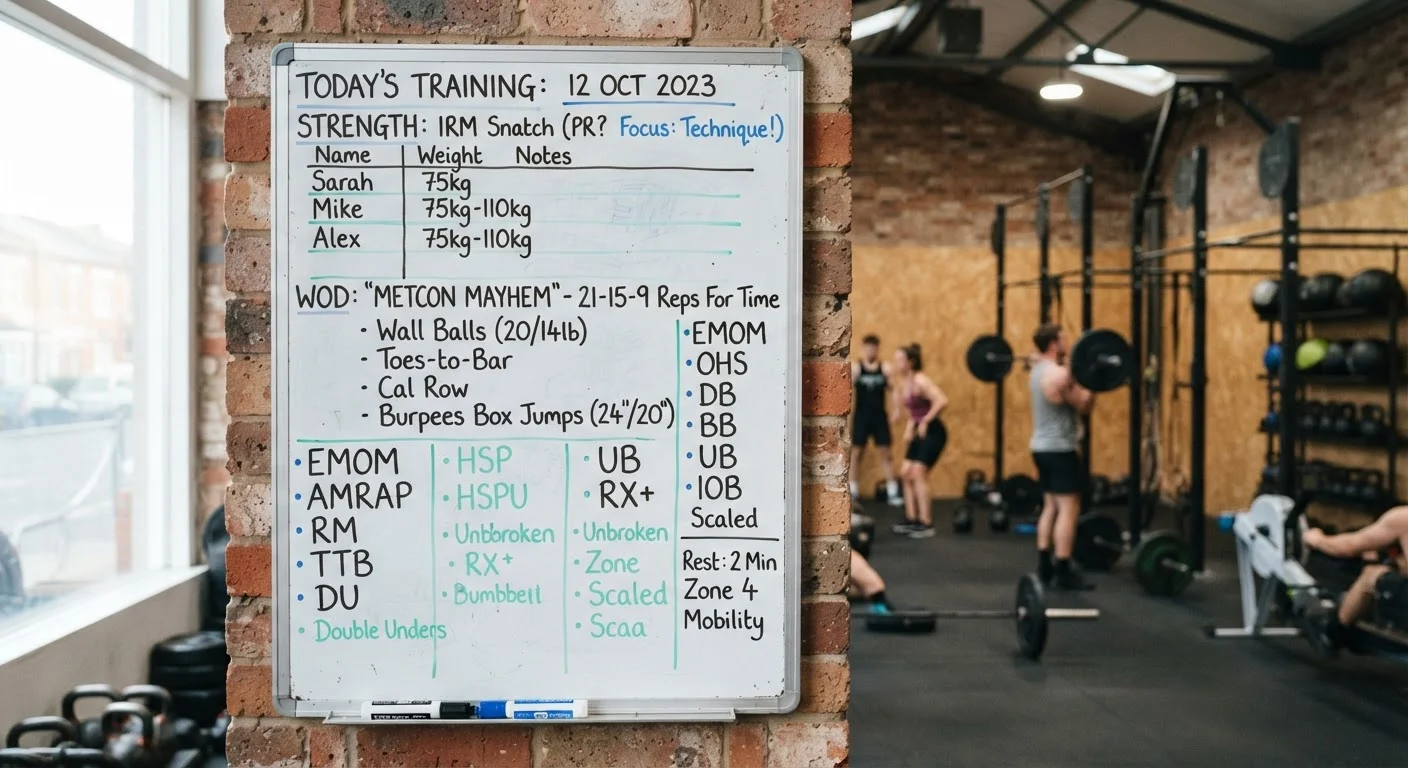
Walk into any gym, open a fitness app, or follow a workout program online, and you'll encounter a steady stream of abbreviations and shorthand: RPE, AMRAP, 1RM, HIIT. For newcomers and even intermediate exercisers, this terminology can feel like a barrier rather than a guide.
It doesn't have to be. Understanding these terms gives you the ability to follow programming accurately, communicate with coaches, and track your progress meaningfully. This reference covers the most common fitness abbreviations and concepts you're likely to encounter, organized so you can look up what you need without wading through unnecessary detail.
For a comparable quick-reference resource in another area of daily life, see our personal finance terms guide - the same plain-language format applied to money vocabulary.
| RPE Scale Range | 1 (complete rest) to 10 (maximal effort) (Borg Scale, adapted for resistance training) |
| AMRAP Format | Time-capped; complete as many rounds/reps as possible |
| Common HIIT Work-to-Rest Ratio | 1:1 to 1:4, depending on protocol (Varies by program design) |
| 1RM Use in Programming | Training loads often set at 60-85% of 1RM (NSCA Strength & Conditioning principles) |
| VO2 Max Units | mL of oxygen per kg of body weight per minute |
| Progressive Overload Principle | Foundational to strength, hypertrophy, and endurance training (Exercise science consensus) |
Core Training Terms Defined
The following terms appear across strength training, group fitness classes, and endurance programming. Knowing them precisely - not just roughly - makes your workouts more intentional.
RPE (Rate of Perceived Exertion)
A subjective 1-10 scale measuring how hard an effort feels during exercise. It allows individuals to self-regulate intensity based on personal capacity rather than fixed external numbers.
AMRAP
Stands for "As Many Rounds (or Reps) As Possible." A time-capped workout format in which the goal is to complete as many repetitions or full rounds of a circuit as possible within a set time.
HIIT (High-Intensity Interval Training)
A training method alternating short bursts of near-maximal effort with brief recovery periods. Research suggests it can improve cardiovascular fitness efficiently in less total time than steady-state cardio.
1RM (One-Rep Maximum)
The maximum amount of weight a person can lift for one complete repetition of a given exercise with proper form. It is commonly used as a reference point for setting training loads.
EMOM
Stands for "Every Minute On the Minute." A structured format in which a set number of reps is performed at the start of each minute, with the remaining time in that minute used for rest.
VO2 Max
The maximum rate at which the body can consume oxygen during intense exercise. It is widely used as a marker of aerobic (cardiovascular) fitness and endurance capacity.
RIR (Reps in Reserve)
An effort measure expressing how many additional repetitions a person could have performed before reaching muscular failure. An RIR of 2 means the set ended two reps before maximum effort.
Progressive Overload
The principle of gradually increasing training stress - through load, volume, frequency, or intensity - over time to continue driving fitness adaptations. It is considered a foundational principle of strength and conditioning.
One term worth extra attention is RPE (Rate of Perceived Exertion). RPE is typically scored on a 1-10 scale, where 1 is complete rest and 10 is maximum effort. Coaches use it because it's individualized - a 7 RPE means challenging but sustainable for you, regardless of the weight on the bar or pace on the track. It's a practical tool for auto-regulating intensity when external metrics like heart rate monitors aren't available.
AMRAP - As Many Rounds (or Reps) As Possible - is a time-domain format common in functional fitness and circuit training. A typical AMRAP assigns a fixed time window (say, 10 minutes) and a sequence of exercises; the goal is to complete as many full rounds as possible. It simultaneously tests fitness and provides a repeatable benchmark.
For a deeper look at how aerobic capacity underpins endurance work, see our article on what aerobic fitness actually means.
Measurement and Programming Shorthand
Beyond exercise formats, fitness content uses a standardized shorthand for sets, reps, and loading schemes. Reading these correctly ensures you perform the intended stimulus - not an easier or harder version of it.
- Sets × Reps: Written as
3×8, meaning 3 sets of 8 repetitions each. - 1RM (One-Rep Maximum): The maximum load you can lift for exactly one full repetition of an exercise. Percentages of 1RM (e.g., "work at 75% 1RM") are a common way to prescribe training intensity in strength programs.
- EMOM (Every Minute On the Minute): A timed format where you begin a prescribed set of reps at the start of each minute. Rest fills the remaining time in each minute.
- Tempo notation (e.g., 3-1-2-0): Describes the speed of each phase of a lift - eccentric (lowering), pause at bottom, concentric (lifting), pause at top - in seconds.
- RIR (Reps in Reserve): Similar to RPE, but expressed as how many more reps you could have done before failure. An RIR of 2 means you stopped two reps short of your limit.
Percentages of 1RM: Use With Caution
Programs written for general audiences often prescribe loads as a percentage of your one-rep maximum (e.g., "lift at 70% 1RM"). However, true 1RM testing involves heavy, maximal effort and carries injury risk if performed without proper preparation and supervision. Many coaches recommend using a calculated estimate based on a multi-rep set rather than testing a true single-rep max, especially for beginners. Always prioritize form and consult a qualified trainer before attempting maximal lifts.
Understanding these conventions helps you follow programs written by coaches you've never met and ensures the intensity delivered matches the intensity intended.
This article is for general informational and educational purposes only and is not a substitute for professional fitness or medical advice. Consult a qualified healthcare provider before beginning any new exercise program, particularly if you have an existing health condition.