The Permit System: Why You Can't Just Show Up
There is a particular kind of heartbreak that comes from driving four hours to a national park entrance only to be turned away - and it happens more often than visitors expect. Over the past decade, surging attendance at marquee parks like Zion, Yosemite, Acadia, and Rocky Mountain has prompted the National Park Service (NPS) to introduce timed-entry permit systems during peak periods.
These reservations are separate from camping permits and are often required simply to enter the park by car on busy summer weekends. They open weeks in advance on Recreation.gov - the federal booking platform - and slots at the most popular parks can disappear within minutes of release.
Check the Official NPS Page Before Every Trip
Permit requirements, fee structures, and seasonal closures change regularly and vary by park. The most reliable source is always the individual park's page at nps.gov - not third-party booking sites or travel blogs. Set a reminder to re-check closer to your travel date, as some policies update mid-season.
For first-timers, the practical lesson is simple: research your specific park's current entry requirements on the official NPS website (nps.gov) well before you travel. Requirements change seasonally and year to year, so a visit that was walk-up friendly two years ago may now require advance planning. If your dates are flexible, midweek visits and early-morning arrivals almost always face fewer restrictions than weekend afternoons.
Passes, Fees, and How Entrance Works
Most national parks charge an entrance fee, typically per vehicle and valid for seven consecutive days. The fee structure varies - a busy canyon park charges differently from a remote grassland - but the more useful tool for frequent visitors is the America the Beautiful Annual Pass, issued by the federal government and covering entrance fees at over 2,000 NPS sites and other federal lands.
Several free or reduced-cost versions exist: active military and their families enter free year-round; US fourth-graders receive a free pass through the Every Kid Outdoors program; and US citizens or permanent residents with permanent disabilities qualify for a free lifetime Access Pass. These are verified and issued at park entrance stations or through Recreation.gov.
Timed-entry permit
A reservation required to enter a park (or specific area) during a set time window on a given day, separate from camping permits or trail-specific permits.
Recreation.gov
The official US federal government online platform where visitors book campsite reservations, timed-entry permits, and activity permits for national parks and other federal lands.
Leave No Trace
A widely adopted set of outdoor ethics principles designed to minimize human impact on natural environments, covering everything from waste disposal to wildlife interaction.
America the Beautiful Pass
An annual pass issued by the federal government that covers entrance fees at national parks and over 2,000 other federal recreation sites for a single annual fee.
Shoulder season
The periods just before and after a destination's peak tourist season - typically spring and fall for US national parks - when crowds are smaller and conditions are often still favorable.
NPS
The National Park Service, the federal agency within the US Department of the Interior that manages national parks, monuments, historic sites, and other protected federal lands.
One important nuance: a park entrance fee does not cover camping, guided tours, or certain special-use permits. Those are booked and paid separately. Many first-timers are surprised to learn that a permit to hike Half Dome in Yosemite, for example, involves a lottery completely independent of park entry.
Crowds, Seasons, and Timing Your Visit
Summer fills trailheads with school-break families, which makes July and August simultaneously the most visited and, for many, the least enjoyable months in popular parks. Parking lots overflow by 8 a.m.; signature viewpoints feel more like queues than wilderness.
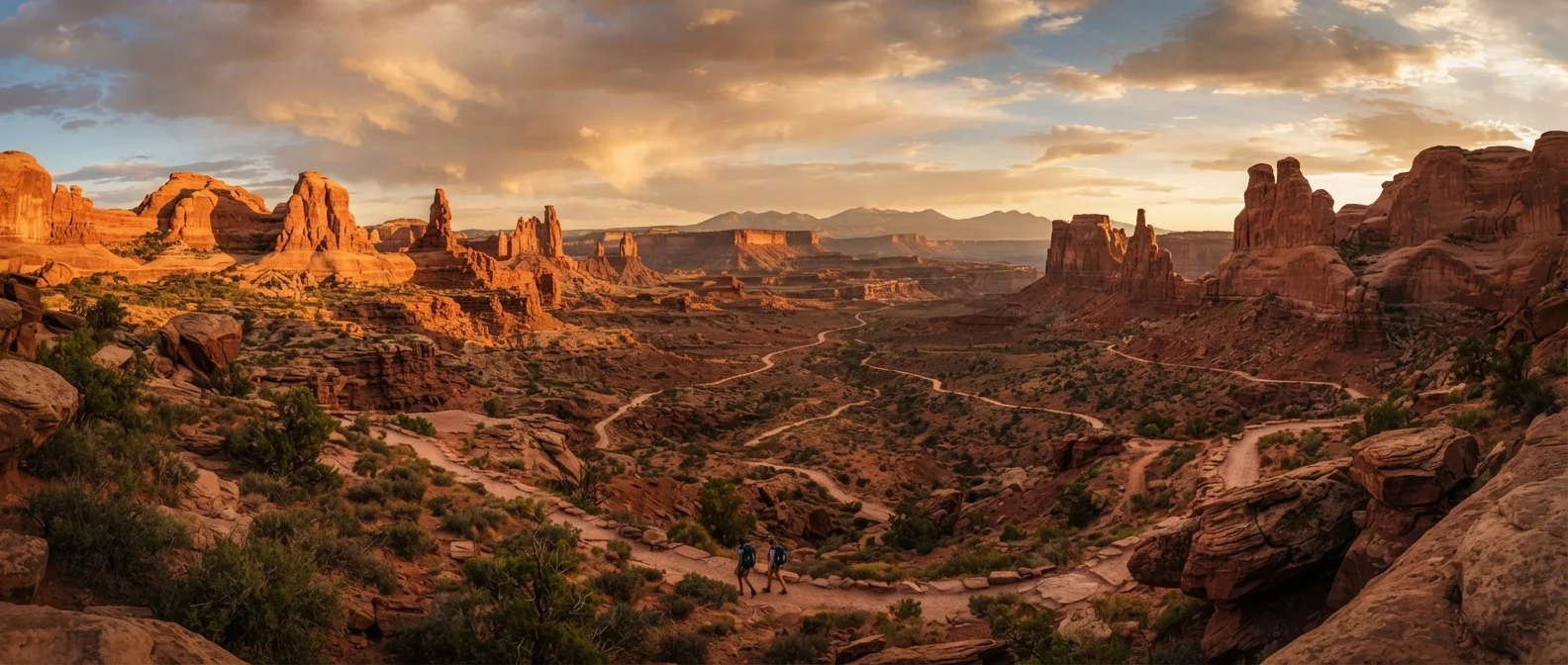
Shoulder seasons reframe the experience entirely. In Arches National Park, October brings cooler temperatures and a quality of amber light that photographers return for annually. Shenandoah in late October blazes with color. The Olympic Peninsula in spring is lush and comparatively quiet. Each park has its own seasonal personality - desert parks like Joshua Tree are often most pleasant from October through April, while high-elevation parks like Glacier or Rocky Mountain may not be fully accessible until June or July.
If you're combining a park visit with a longer road journey, our interstate road trip guide covers the logistics of long-distance driving that pairs naturally with park hopping.
Weather Can Change Fast in Elevated Parks
High-elevation parks like Rocky Mountain and Glacier can experience snow, lightning, and near-freezing temperatures even in summer. Afternoon thunderstorms are common and can build quickly above treeline. Always check the daily forecast at the park's visitor center or NPS weather page before heading out, and carry layers regardless of the morning temperature.
Safety, Leave No Trace, and What Rangers Want You to Know
Rangers field the same preventable emergencies with regularity: dehydration on desert trails, wildlife encounters from feeding animals, and hikers stranded after underestimating distances and elevation gain. Before any trail, check the current conditions report posted at the visitor center, carry more water than you think you need, and never assume cell service will be available for navigation or emergency calls.
Leave No Trace is not a slogan - it's a set of practices that protect the ecosystems every visitor came to experience. In practice, this means packing out all trash, staying on designated trails to protect fragile vegetation, keeping distance from wildlife, and never removing rocks, plants, or natural objects. At heavily visited parks, even small individual impacts accumulate into significant ecological damage over millions of annual visits.
Wildlife safety deserves specific attention. Bears, mountain lions, bison, and moose are not photo props - they are wild animals whose behavior is unpredictable. Every park posts current wildlife safety guidance; following it isn't optional. For visitors planning to explore solo, our solo travel safety guide offers relevant habits around itinerary sharing and staying connected in remote areas.
Wildlife Is Unpredictable - Keep Your Distance
Approaching, feeding, or attempting to photograph wildlife at close range is dangerous and prohibited in all national parks. Even seemingly docile animals like bison have injured visitors who underestimated them. The NPS recommends staying at least 25 yards from most wildlife and 100 yards from bears and wolves. Violating these guidelines can result in fines and puts both you and the animal at risk.
Beyond the Famous Parks: Hidden Gems Worth the Trip
The NPS manages more than 400 sites - national monuments, seashores, historic sites, recreation areas, and parkways - the vast majority of which see a fraction of the foot traffic that Yellowstone or the Grand Canyon absorb. These quieter sites often deliver comparable landscapes with the added reward of genuine solitude.
Great Sand Dunes in Colorado, Congaree in South Carolina, and Guadalupe Mountains in Texas each offer experiences that rival more famous counterparts, with far less logistical friction. Slot canyons, old-growth forests, and ancient ruins are accessible in national monuments that don't require advance permits or strategic alarm-clock reservations.
For travelers who enjoy the challenge of researching unfamiliar destinations, our guide to researching lesser-known places applies equally well to off-the-radar parks. The broader Travel Tips hub is also a useful starting point for planning any US-based journey. America's park system is wide, generous, and full of places that will surprise even seasoned travelers - the key is simply knowing where to look, and when to go.
NPS Official Website (nps.gov)
The authoritative source for park-specific entry requirements, permit systems, trail conditions, and visitor safety information for all 400+ NPS-managed sites.
Recreation.gov
The federal booking platform for campsite reservations, timed-entry permits, and activity permits across national parks and other federal lands.
Leave No Trace Center for Outdoor Ethics
Detailed, principle-by-principle guidance on minimizing environmental impact in natural settings, from trail etiquette to wildlife interaction.