
Why These Myths Matter
Budgeting has a reputation problem. Somewhere between personal finance advice and pop culture, the concept became loaded with baggage - it's seen as something only broke people do, or a punishing regimen that turns every dinner out into a guilt trip. Those stories keep a lot of people from ever getting started.
The reality is far more straightforward. A budget is simply a plan for how your money moves - nothing more, nothing less. For a fuller picture of what that actually means, see what a budget actually is. Before you can build a useful one, it helps to clear out the myths that might be standing in your way.
Myth
Budgeting is only for people who are struggling financially or in debt.
Fact
Budgeting is a planning tool that benefits anyone with income - regardless of how much they earn or owe.
This is one of the most pervasive myths, and it stops a lot of financially comfortable people from ever thinking critically about their money. The idea that budgets are remedial - something you do when things go wrong - misses their core purpose.
A budget isn't a sign of trouble. It's a map. High earners who don't track their spending often find themselves with surprisingly little to show for their income. Meanwhile, plenty of people with modest salaries build meaningful savings by being intentional about where their money goes. The relationship between budgeting and debt is real, but debt isn't a prerequisite for getting started.
Myth
You have to track every single purchase to make a budget work.
Fact
Effective budgets focus on categories and patterns, not a forensic accounting of every transaction.
Obsessive transaction logging is one reason people abandon budgets quickly. If the system feels like surveillance, it won't last. The good news is that granular tracking isn't required for a budget to do its job.
Most people benefit from watching a handful of categories - housing, food, transportation, and discretionary spending - rather than cataloging every coffee. Approaches like envelope budgeting work precisely because they set limits by category upfront, removing the need for exhaustive daily tracking. Consistency matters far more than precision.
Myth
A budget means giving up things you enjoy.
Fact
A well-built budget includes spending on things you value - that's the point of planning ahead.
Restriction is the image most people carry of budgeting, and it's the wrong one. The goal of a budget isn't to eliminate enjoyment; it's to make sure spending reflects what you actually care about rather than drifting by default.
When you plan for discretionary spending - dining out, entertainment, hobbies - that spending becomes intentional rather than accidental. You're not sacrificing; you're choosing. Popular frameworks like the 50/30/20 rule codify this by building in a dedicated category for wants, though that rule doesn't fit every household. The principle holds regardless of the specific method you use.
Myth
Budgeting takes too much time and requires complicated tools.
Fact
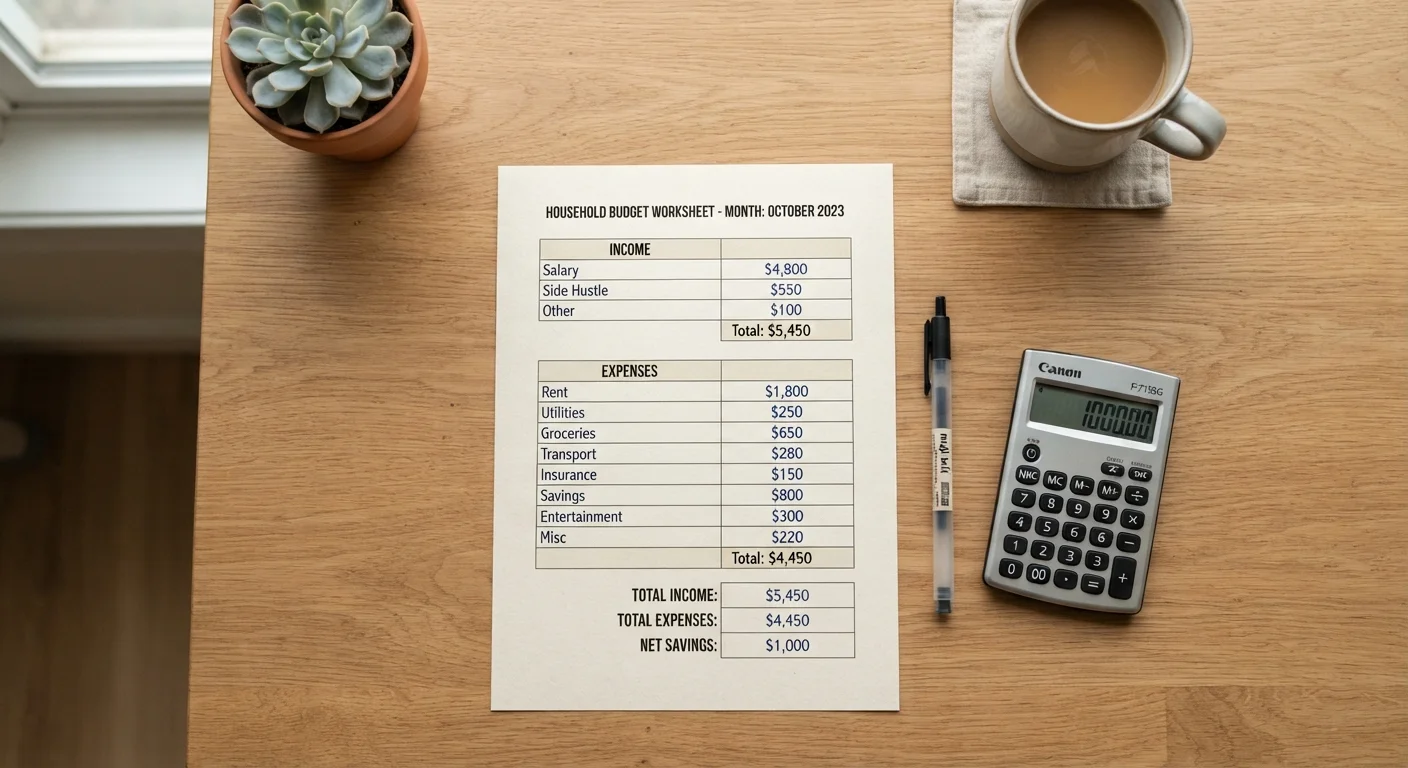
A functional budget can be built in under an hour using nothing more than a pen, paper, or a basic spreadsheet.
The financial industry has an interest in making money management look complex - and a whole ecosystem of apps and software has grown up around that perception. But complexity is optional, not required.
A simple budget lists your expected income, your essential expenses, your savings target, and what's left for discretionary spending. That's it. Plenty of people run effective budgets on a single sheet of paper or a basic spreadsheet. The tools should serve the habit, not replace it. Once the habit is in place, the behaviors that make budgeting stick are less about systems and more about consistency.
Myth
If your income is unpredictable, budgeting doesn't work for you.
Fact
People with variable income can budget effectively by anchoring to baseline expenses and building income buffers.
Freelancers, gig workers, and anyone whose paycheck varies month to month often assume that budgeting requires the kind of predictability they don't have. This assumption leads to no plan at all - which tends to produce worse outcomes than an imperfect one.
Variable-income budgeting typically works by identifying the non-negotiable monthly expenses first, then building a buffer from higher-earning months to cover leaner ones. This approach treats income as an average rather than a fixed number. It's a different method, but a workable one. The key insight is that an emergency fund plays a central role in this - building one inside your budget is more feasible than most people think.
Getting Started Without Overthinking It
Once the myths are out of the way, the practical barrier to starting is much lower than most people expect. You don't need a finance degree, specialized software, or a perfectly stable income. You need a realistic picture of what comes in, a rough sense of where it goes, and a few categories that matter most to you.
Understanding the difference between your fixed and variable expenses is one of the most concrete first steps - knowing that distinction changes how you budget in a meaningful way. If your income varies month to month, that's not a dealbreaker either; there are practical frameworks designed specifically for budgeting on an irregular income.
Don't Wait for the Perfect Moment to Start
A common trap is waiting until income stabilizes, debt is paid off, or a new month begins before starting a budget. That moment rarely arrives on schedule. An imperfect budget started today will generally outperform a perfect one that never gets written. Starting small - even with just two or three spending categories - builds the habit that a more detailed system can grow from later.
The first budget you build doesn't have to be perfect - it just has to exist. Many people find that even a rough version reveals spending patterns they weren't aware of, and that awareness alone can shift behavior. If you want to understand what tends to derail people after the initial setup, why budgets fail in month two covers the most common tripping points and how to get past them.
This article is for general informational purposes only and does not constitute personalized financial advice. Consider consulting a qualified financial professional for guidance specific to your situation.