How Each Type Is Constructed
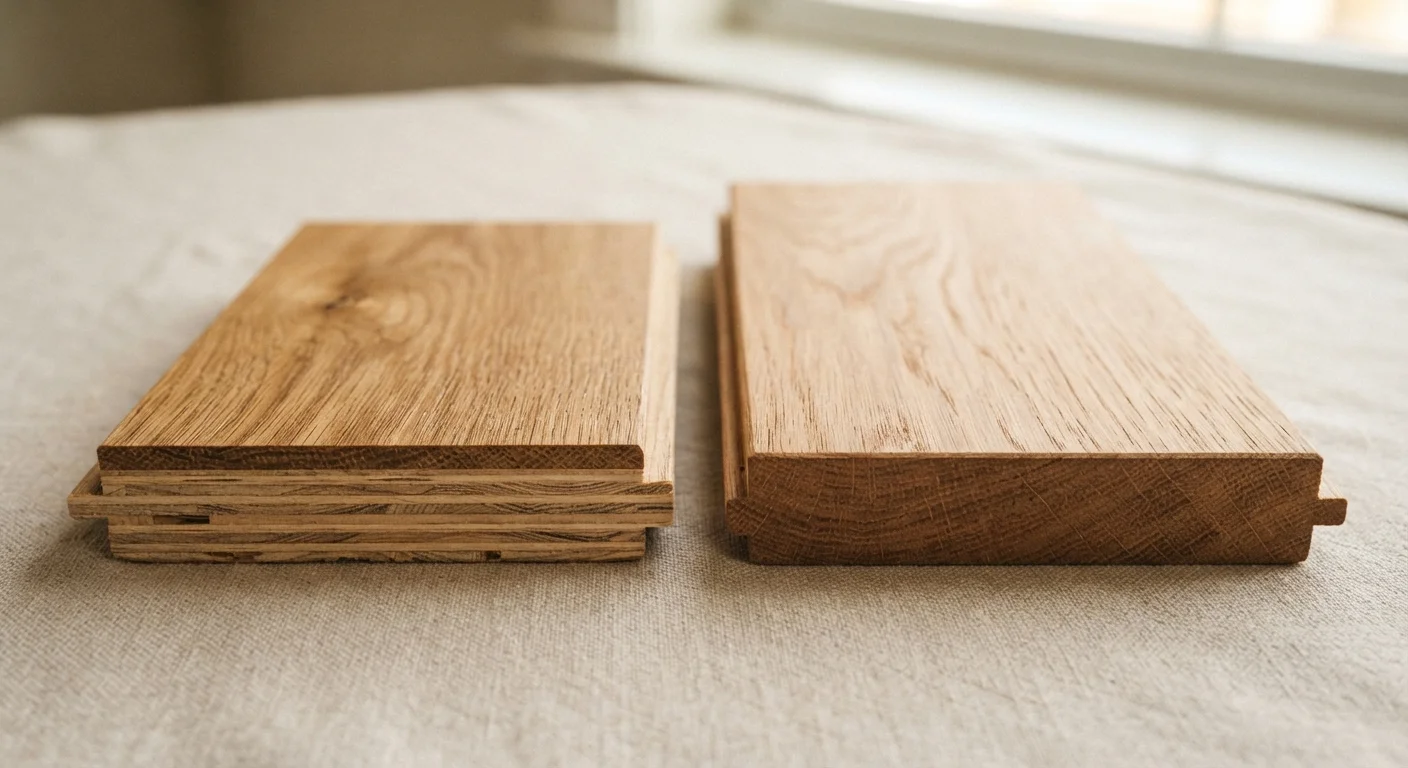
The most fundamental difference between these two flooring types is what's inside the plank. Solid hardwood is milled from a single piece of wood from top to bottom - typically ¾ inch thick. Every layer is the same species, which gives the plank uniform grain and allows for repeated sanding over its life.
Engineered hardwood, by contrast, is built from multiple layers bonded together. A real hardwood veneer sits on top - typically 1/12 to 1/6 inch thick - while the core layers are made from plywood or high-density fiberboard arranged in alternating directions. This cross-ply construction is what gives engineered hardwood its dimensional stability. When humidity or temperature changes, the layers work against each other's tendency to expand and contract, reducing warping and gapping.
It's worth understanding that engineered hardwood is still genuine wood - the surface you walk on and see is real hardwood. As explored in our broader flooring guide, choosing the right flooring material often comes down to how a product is constructed, not just how it looks.
| Criterion | Engineered Hardwood | Solid Hardwood |
|---|---|---|
| Construction | Real wood veneer over plywood/HDF core | Single solid wood plank throughout |
| Moisture resistance | Better - stable in humidity swings | Lower - prone to warping and cupping |
| Subfloor compatibility | Concrete, wood, radiant heat | Wood subfloor above grade only |
| Installation methods | Float, glue, or nail/staple | Nail or staple down |
| Refinish potential | 1-3 times (veneer dependent) | 6+ times over lifespan |
| Typical lifespan | 25-30+ years | 50-100 years (with care) |
| Radiant heat compatible | Often yes - check manufacturer | Generally not recommended |
Moisture, Temperature, and Subfloor Compatibility
This is where the two options diverge most sharply. Solid hardwood is sensitive to moisture and humidity swings. Wood expands when it absorbs moisture and contracts when it dries out. In rooms with inconsistent climate control - or over concrete slabs that emit moisture vapor - solid hardwood can cup, warp, or develop gaps. Most manufacturers advise against installing solid hardwood below grade or directly over concrete.
Engineered hardwood's layered core significantly reduces this movement. Many engineered products are suitable for installation over concrete (with appropriate vapor barriers), in basements with controlled humidity, and over radiant heat systems. Always verify the specific product's manufacturer guidelines, as compatibility varies.
3mm+
Veneer thickness needed for refinishing engineered hardwood
Flooring industry guidelines generally indicate that engineered planks with a veneer below 2mm are not suitable for sanding and refinishing.
¾ inch
Standard thickness of solid hardwood planks
The National Wood Flooring Association cites ¾-inch planks as the traditional standard, enabling multiple sanding cycles over a floor's lifetime.
30-50%
Typical humidity range recommended for wood floors
Most hardwood flooring manufacturers recommend maintaining indoor relative humidity between 30% and 50% to minimize expansion and contraction.
Neither type is appropriate for wet areas such as bathrooms or laundry rooms, where waterproof flooring options are a safer fit.
Installation Methods and DIY Feasibility
Solid hardwood is typically installed using nail-down or staple-down methods, which require a wood subfloor and specialized flooring tools. This generally places solid hardwood installation in the realm of experienced DIYers or professional installers.
Engineered hardwood opens up more options. Depending on the product, it can be glued down, nailed down, or installed as a floating floor - where planks click together and rest on an underlayment without being fastened to the subfloor. Floating installation is the most accessible DIY method, though it does have limitations in very large rooms where expansion gaps must be carefully managed.
Acclimation Is Not Optional
Skipping acclimation is one of the most common causes of post-installation problems with hardwood floors. Both solid and engineered planks need time to adjust to the room's moisture and temperature before being fastened or locked in place. Follow the specific acclimation window listed in the manufacturer's installation instructions, as it can vary by product and climate. Installing without acclimating can result in visible gaps in dry conditions or buckling in humid ones.
Acclimation matters for both types. Before installation, planks should be stored in the installation space for a manufacturer-specified period - typically 48 to 72 hours - so the wood adjusts to the home's temperature and humidity levels.
Refinishing, Longevity, and Value Over Time
Solid hardwood's biggest long-term advantage is its refinish potential. Because the entire plank is wood, it can be sanded down and refinished repeatedly - often six or more times over its lifespan, depending on the thickness removed each time. With proper care, solid hardwood floors can last 50 to 100 years.
Engineered hardwood's refinish potential depends directly on the veneer layer's thickness. Thicker veneers (above 3mm) may allow one to three refinishes; thinner veneers may allow none. For homeowners prioritizing long-term flexibility, this distinction matters. That said, engineered hardwood installed in stable conditions can last 25 to 30 years or more before refinishing becomes a concern.
Evaluating long-term value means looking past surface appearances. As our article on signals that are easy to mistake for durability notes, premium packaging or a polished finish doesn't always reflect how a product holds up under real-world use. The same applies to flooring: thickness of the wear layer and quality of core construction are more reliable indicators than visual sheen alone.