
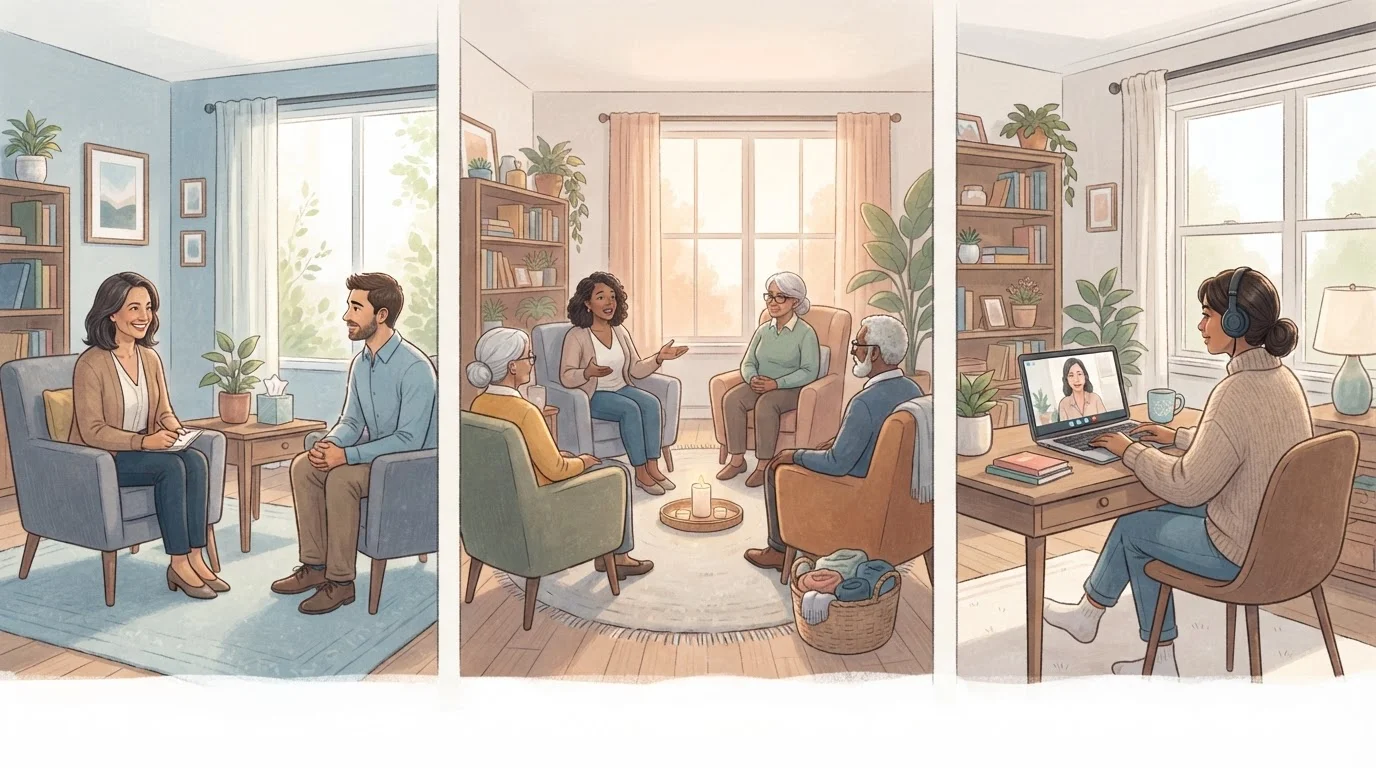
Why Format Matters in Mental Health Care
When most people picture therapy, they imagine a private room with a therapist and a single patient. That image is accurate - but incomplete. Therapy is delivered across several formats, and the structure of each session shapes the experience in meaningful ways. Understanding these differences helps you ask better questions when speaking with a mental health provider and make more informed decisions about your care.
This article covers three broadly used formats - individual, group, and online therapy - and compares them across the dimensions that matter most to patients: privacy, cost, accessibility, and clinical fit. It is not a substitute for professional guidance. Always consult a licensed mental health professional to determine what is appropriate for your situation.
If you're also weighing which type of therapy to pursue, see our comparison of CBT and mindfulness-based approaches for a deeper look at two of the most widely practiced modalities.
Individual Therapy: One-on-One Focus
Individual therapy involves regular sessions between one client and one licensed therapist. It is the most common format and the baseline against which other approaches are often measured.
Key strengths: Sessions are fully tailored to one person's history, goals, and pace. The therapist can adapt techniques session by session, explore sensitive personal material in confidence, and track progress closely. Research consistently supports individual therapy for a broad range of conditions, including depression, anxiety disorders, trauma, and personality-related concerns.
Practical considerations: Individual therapy tends to be the most expensive format per session, though insurance coverage varies. Availability depends on your location and whether local therapists are accepting new clients - a significant constraint in many regions. Sessions typically run 45 to 50 minutes and occur weekly or biweekly.
Therapist Availability Varies Widely
Access to individual therapists - especially those who accept insurance - remains limited in many parts of the United States. If you encounter waitlists, ask providers about interim options such as group programs, telehealth services, or community mental health centers. In a mental health emergency, contact the 988 Suicide and Crisis Lifeline by calling or texting 988.
Group Therapy: Structured Peer Support
Group therapy is a clinician-led session involving multiple participants - typically between five and fifteen people - who share a therapeutic goal or diagnosis. It is distinct from peer support groups, which are not professionally facilitated.
Key strengths: Participants benefit from recognizing that others share their struggles, which can reduce isolation and normalize difficult experiences. Research published across decades of clinical literature suggests group therapy is effective for conditions including depression, substance use disorders, and social anxiety. The group setting also provides a natural environment for practicing interpersonal skills.
Practical considerations: Group sessions are generally less expensive per session than individual therapy, making them more accessible for people with limited coverage. However, the shared setting means less individual airtime and reduced privacy. Group composition and interpersonal dynamics can significantly influence outcomes, so finding a well-matched group matters.
Group and Individual Therapy Can Work Together
Many people attend both individual and group therapy simultaneously. A licensed provider might recommend individual sessions for deep personal work alongside a condition-specific group for peer support. If you're considering therapy, ask your provider whether a combined approach could be beneficial for your situation.
Online Therapy: Access Over Distance
Online therapy - also called teletherapy or telehealth - delivers mental health services via video, phone, or text-based platforms. It expanded dramatically during the COVID-19 pandemic and has remained a substantial part of mental health care delivery.
Key strengths: Geographic barriers are effectively eliminated, allowing people in rural or underserved areas to access licensed professionals. Scheduling flexibility is often greater, and some individuals find it easier to open up from a familiar environment. Studies comparing video-based therapy to in-person sessions for conditions like depression and PTSD have generally found comparable outcomes, though research is ongoing and context-dependent.
Practical considerations: Online therapy requires reliable internet access, a private space, and comfort with technology. It may not be appropriate for all presentations - including acute psychiatric crises or conditions requiring in-person clinical assessment. Insurance coverage for telehealth has expanded but varies by plan and state. Always verify that an online provider is appropriately licensed in your state before beginning care.
| Individual Therapy | Group Therapy | Online Therapy | |
|---|---|---|---|
| Privacy | High - fully private sessions | Lower - shared with group members | Moderate - depends on home environment |
| Personalization | High - tailored to one person | Moderate - shared focus | High - one-on-one with therapist |
| Typical cost per session | Higher | Lower | Variable - often comparable to in-person |
| Peer connection | Absent | Central to the format | Absent (unless group telehealth) |
| Geographic accessibility | Limited by local provider supply | Limited by local provider supply | High - available across distances |
| Evidence base | Extensive across many conditions | Strong for select conditions | Growing - broadly comparable to in-person |
| Technology requirement | None | None | Reliable internet and device needed |
This article is for general informational and educational purposes only and does not constitute medical or mental health advice. Please consult a qualified mental health professional to discuss which therapy format may be appropriate for your individual needs.