
From Personal Feeling to National Conversation
For most of American cultural history, loneliness was treated as a private matter - an emotional state individuals navigated on their own. That framing changed notably in May 2023, when then-U.S. Surgeon General Dr. Vivek Murthy issued a formal advisory declaring loneliness and social isolation a public health epidemic. The advisory cited research linking inadequate social connection to significantly elevated risks of heart disease, stroke, dementia, depression, and premature death.
The declaration was significant not for the novelty of the data - researchers had been tracking social disconnection for decades - but for its political and cultural weight. Framing loneliness as a public health concern places it alongside smoking, obesity, and opioid misuse as conditions warranting coordinated societal response, not simply personal reflection.
That shift in framing has rippled through policy discussions, public media, and community organizing. It has also prompted debate: Are Americans actually more isolated than in previous generations, or are we simply more willing to name it? The evidence suggests both may be partly true.
1 in 2
Americans reporting measurable loneliness
A 2023 Surgeon General advisory cited survey data suggesting approximately half of American adults reported measurable levels of loneliness.
29%
Adults with no close friends in 2021
The American Perspectives Survey found that 29% of Americans reported having no close friends - a share that had grown substantially from surveys taken in the 1990s.
26%
Increased risk of premature death
Research reviewed in the Surgeon General's advisory associated social isolation with approximately a 26% increased likelihood of premature mortality.
15 cigarettes
Daily equivalent health impact of isolation
Public health researchers have estimated the health impact of prolonged social isolation to be comparable to smoking approximately 15 cigarettes per day - a figure frequently cited in Surgeon General communications.
What the Data Reflects About Social Disconnection
Multiple large-scale surveys point in the same direction. A 2023 report from the American Perspectives Survey found that Americans report having fewer close friends than in decades past, with a growing share reporting no close friends at all - a figure that was statistically negligible in earlier surveys. Time-use studies suggest Americans spend more hours alone than they did in the 1960s and 1970s, even after accounting for increased solo work-from-home arrangements that have followed the pandemic era.
Counterintuitively, younger adults - digital natives who are presumed to be highly connected - report some of the highest rates of loneliness in survey data. Researchers have noted a distinction between broad, shallow social networks and the deeper, more reciprocal relationships that appear to buffer against loneliness's health effects. This distinction matters: the number of social media contacts does not reliably predict subjective sense of connection.
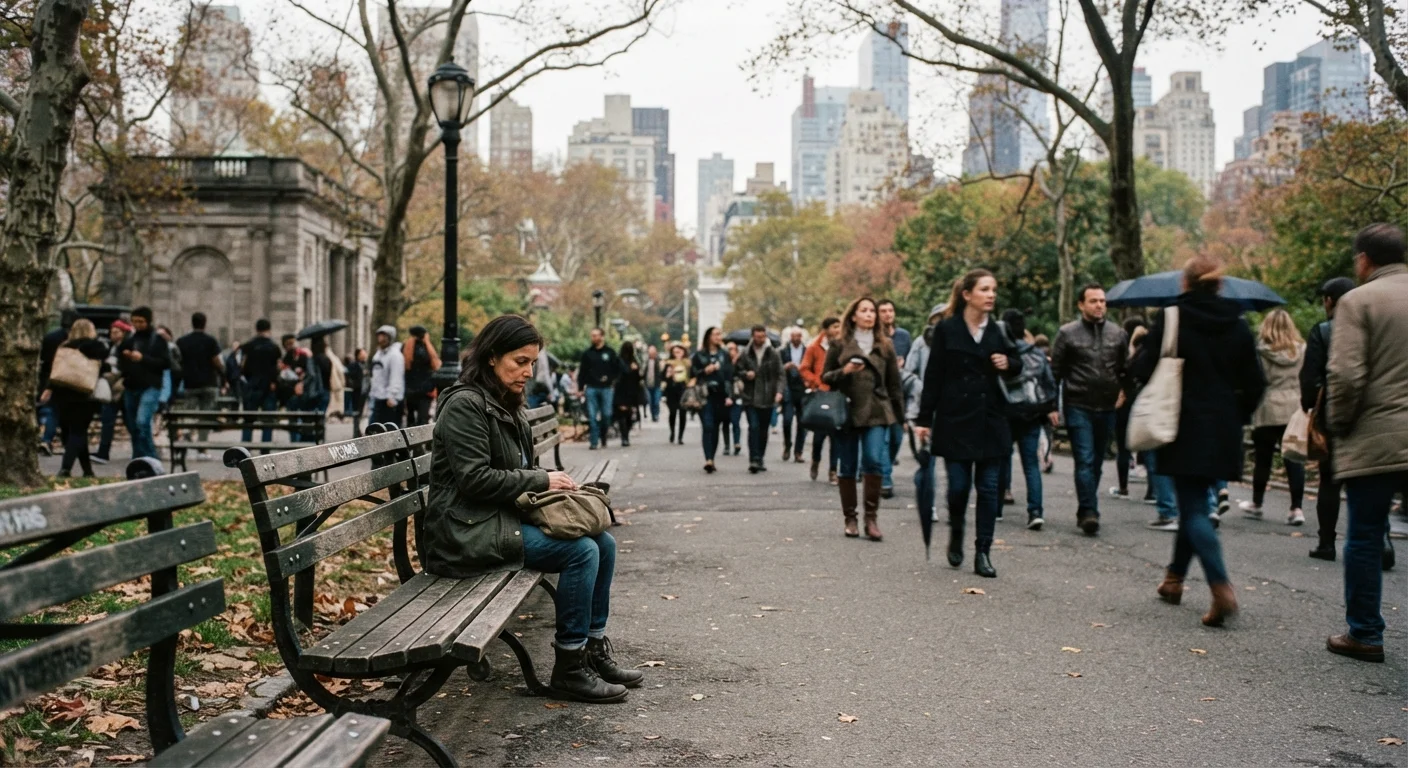
Geographic and economic factors also shape the picture. Rural communities and urban neighborhoods face different but overlapping isolation pressures - rural residents may lack nearby social infrastructure, while urban residents can be surrounded by people yet lack genuine social ties.
“Loneliness and weak social connections are associated with a reduction in lifespan similar to that caused by smoking 15 cigarettes a day, and even greater than that associated with obesity. Given the profound consequences of loneliness and isolation, we have an opportunity and an obligation to make the same investments in addressing social connection that we have made in addressing other critical public health issues.”
— Vivek Murthy, Former U.S. Surgeon General, author of the 2023 Advisory on the Healing Effects of Social Connection and Community
The Structural Roots of American Isolation
Public health researchers and sociologists argue that loneliness cannot be understood without examining the built environments and institutions that shape social life. American communities have, over several decades, shifted toward suburban and exurban development patterns that reduce incidental social contact - the sidewalk conversations, neighborhood gathering places, and walkable commercial districts that once facilitated casual connection.
Civic participation has also declined. Membership in religious institutions, community organizations, labor unions, and civic clubs fell steadily through the late 20th century, a trend documented by sociologist Robert Putnam in his influential work on social capital. These institutions functioned as social infrastructure - not just communities of belief or interest, but reliable contexts for repeated, low-stakes human contact.
The transformation of American work patterns adds another dimension. Remote work and shifting job structures have altered the daily rhythms that once organically created social contact, even for workers who didn't socialize beyond the office. For many Americans, the workplace was a primary site of adult social life - its erosion as a consistent gathering place leaves a structural gap that individuals are left to fill on their own.
Understanding the Policy Framing Shift
Calling loneliness a 'public health epidemic' is a deliberate rhetorical and policy choice. It signals that the problem requires institutional responses - urban planning, workplace policy, community investment - rather than individual behavioral change alone. When you encounter this language in journalism or policy documents, it reflects an argument about where responsibility and solutions should be located: not solely with individuals, but with systems and institutions.
Community Responses and the Limits of Individual Solutions
The public health framing of loneliness matters in part because it pushes back against the tendency to prescribe individual behavioral fixes - join a club, volunteer more, put down the phone - for what are fundamentally structural conditions. Researchers broadly agree that while individual choices matter, sustainable reductions in social isolation require community and policy-level changes: walkable urban design, investment in public gathering spaces, flexible work arrangements that support community participation, and support for civic institutions.
Online communities have emerged as one partial response. Digital communities increasingly bridge into offline action, organizing mutual aid, local meetups, and civic engagement in ways that can provide genuine connection. The evidence on whether online interaction reduces loneliness is nuanced, however - reciprocal, engaged participation in digital communities differs substantially from passive consumption of social media feeds.
The broader conversation about loneliness also intersects with mental health and social connection research, which has established that the relationship between social contact and well-being is more complex than simply spending time near others. The quality, reciprocity, and meaning of relationships shape outcomes more than raw social exposure. That finding reinforces the case for structural investment in conditions that foster genuine community, not just proximity.
This article is for general informational purposes only and does not constitute medical or mental health advice. If you are experiencing significant distress or mental health challenges, please consult a qualified healthcare professional.