
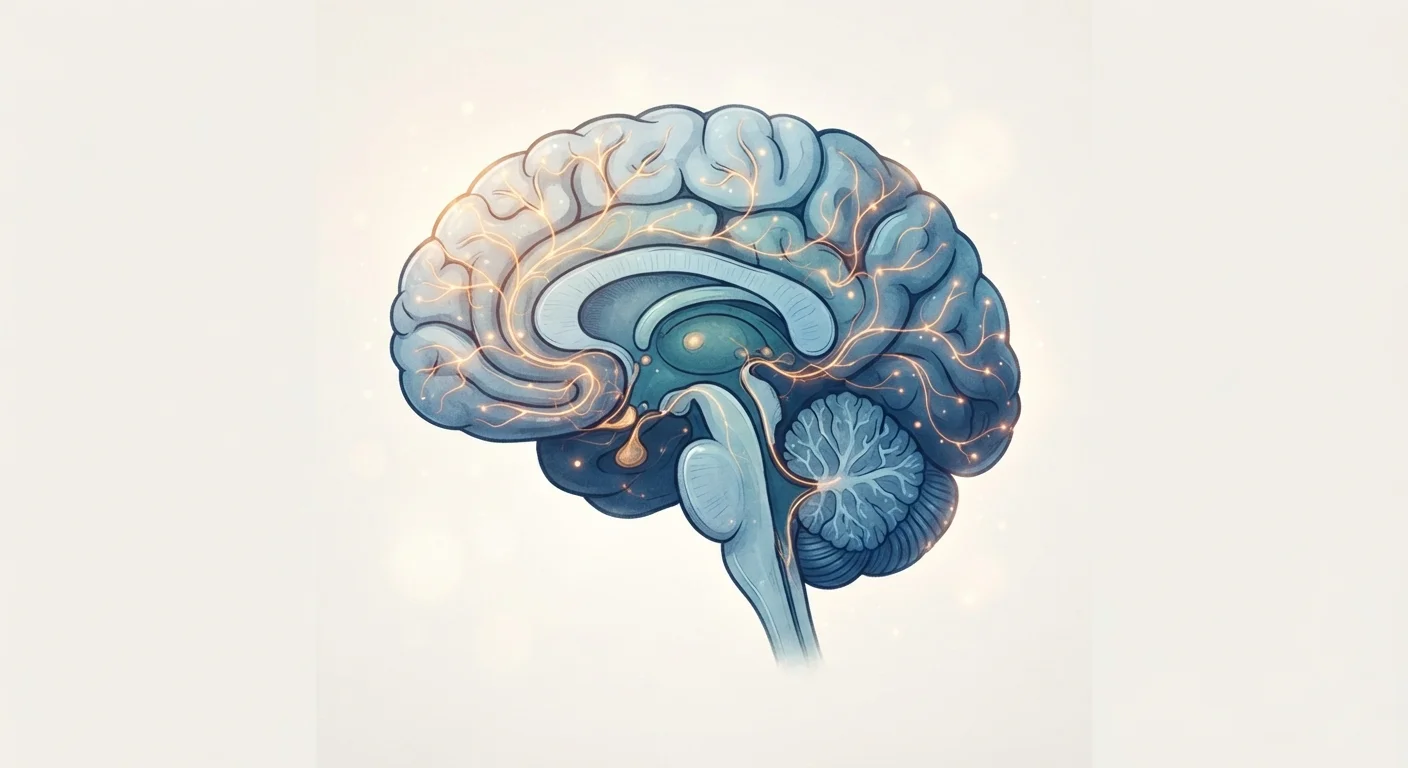
The Brain's Alarm System: What Stress Was Designed to Do
The human stress response evolved as a survival mechanism. When the brain perceives a threat, the amygdala - a small, almond-shaped structure deep in the brain - fires a rapid distress signal. This triggers the hypothalamus to activate the sympathetic nervous system, releasing adrenaline and, shortly after, the hormone cortisol from the adrenal glands.
In short bursts, this cascade is adaptive. Heart rate rises, attention sharpens, and energy is redirected toward immediate action. The system was built for acute threats - a genuine emergency that resolves within minutes or hours. The problem arises when stressors are chronic: financial strain, caregiving demands, workplace conflict, or ongoing health concerns that have no clear endpoint.
Under these conditions, the alarm never fully resets. And a brain that never stops sounding the alert begins to reorganize itself around that heightened state. As research in the field of psychoneuroendocrinology has shown, this reorganization is not merely functional - it is structural.
How Chronic Cortisol Reshapes Brain Regions
Three brain regions bear the brunt of sustained cortisol exposure:
~10-20%
Reduction in hippocampal volume observed in chronic stress studies
Multiple neuroimaging studies have documented reduced hippocampal volume in individuals with prolonged stress or stress-related disorders, including PTSD.
3-5×
Increased depression risk with chronic stress exposure
Research in psychiatry consistently identifies sustained psychosocial stress as one of the strongest modifiable risk factors for developing major depressive disorder.
30 min
Of moderate aerobic exercise linked to cortisol regulation benefits
Studies in exercise physiology suggest regular moderate-intensity aerobic activity supports healthier cortisol rhythms and promotes hippocampal neurogenesis.
The Hippocampus
The hippocampus is central to memory formation and spatial navigation. It is also densely packed with cortisol receptors. Studies using neuroimaging have found that individuals with prolonged stress exposure, including those with post-traumatic stress disorder, tend to show reduced hippocampal volume. High cortisol appears to suppress neurogenesis (the birth of new neurons) and weaken synaptic connections in this region, contributing to the memory lapses and difficulty concentrating that chronically stressed people commonly report.
The Prefrontal Cortex
The prefrontal cortex (PFC) governs rational thinking, impulse control, and planning - the cognitive functions most people associate with sound judgment. Chronic stress reduces dendritic branching in the PFC, essentially pruning the connections that support these higher-order functions. This is one reason chronic stress is associated with poorer decision-making, shorter temper, and difficulty seeing problems clearly.
The Amygdala
In contrast to the hippocampus and PFC, the amygdala tends to grow under chronic stress. A larger, more reactive amygdala means the threat-detection system becomes hypersensitive - interpreting neutral situations as dangerous and responding disproportionately. This helps explain why chronically stressed individuals often feel inexplicably anxious or irritable even when circumstances seem objectively manageable. Understanding this dynamic is part of why dismissive reassurance rarely helps someone who is genuinely struggling.
What This Means for Thinking, Mood, and Behavior
The neurological shifts described above have real, everyday consequences that are easy to misattribute to laziness, weakness, or poor character. Difficulty focusing at work, forgetting appointments, snapping at loved ones, struggling to make simple decisions - these are not personality flaws. They are downstream effects of a brain operating under sustained biological strain.
“The architecture of the brain is not fixed. Chronic stress remodels it - but so does recovery. Understanding this gives us a basis for genuine therapeutic optimism rather than fatalism.”
— Bruce McEwen, Neuroendocrinologist and pioneer of allostatic load research, Rockefeller University
Chronic stress also disrupts the balance of neurotransmitters including serotonin, dopamine, and GABA - chemical messengers that regulate mood, motivation, and the ability to feel calm. This partially explains why prolonged stress is a significant risk factor for both anxiety disorders and depression, according to established clinical research.
Behavioral patterns that develop under chronic stress - avoidance, withdrawal, overworking - can themselves further erode resilience over time. The habits that quietly undermine emotional resilience often feel adaptive in the short term, making them particularly difficult to recognize from the inside.
Talk to a Professional Early
If you recognize several of these cognitive and emotional patterns in yourself, consider speaking with a primary care provider or mental health professional sooner rather than later. Early support can reduce the cumulative neurological burden of chronic stress. These symptoms are well within the scope of professional care - do not wait until you are in crisis to seek help.
The Hopeful Side: Neuroplasticity and Recovery
Perhaps the most clinically important aspect of stress neuroscience is this: the brain is not static. Neuroplasticity - the brain's ability to reorganize, form new connections, and recover structure - means that many stress-related changes are reversible with the right conditions.
Evidence-based interventions including cognitive behavioral therapy (CBT), mindfulness-based stress reduction (MBSR), regular physical activity, and adequate sleep have all been associated with structural and functional brain improvements in peer-reviewed research. Physical exercise, in particular, promotes neurogenesis in the hippocampus and supports cortisol regulation.
This is not a promise of any specific outcome - individual results vary, and recovery timelines differ widely depending on history, biology, and circumstance. The key message is that chronic stress is a medical and neurological phenomenon, not a personal failing. People experiencing its effects deserve the same quality of professional evaluation and care as any other health condition.
This article is for general informational and educational purposes only and does not constitute medical advice. If you are concerned about stress, mental health symptoms, or cognitive changes, please consult a qualified healthcare professional.