
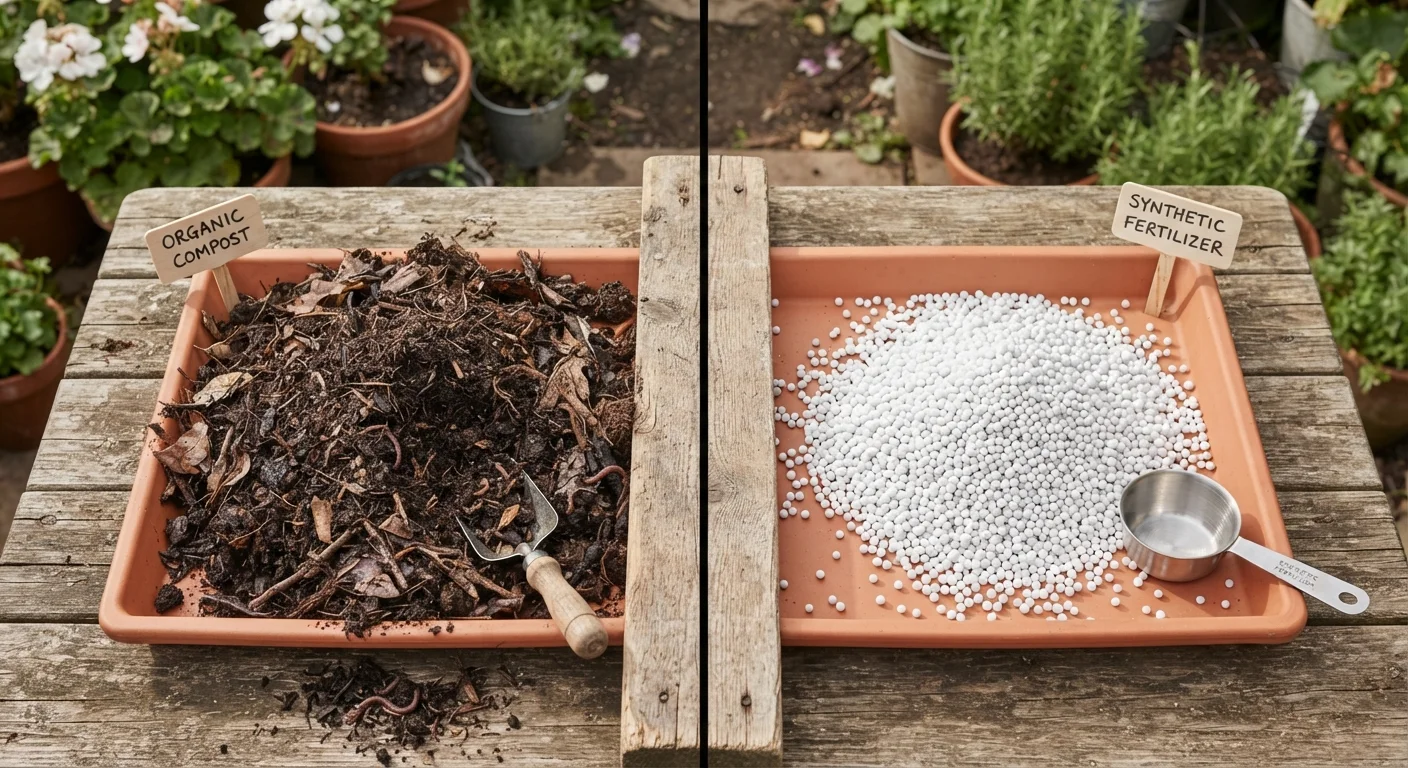
How Each Type Delivers Nutrients to Plants
The most fundamental difference between organic and synthetic fertilizers is how they make nutrients available to plant roots.
Organic fertilizers - including compost, bone meal, blood meal, and fish emulsion - are derived from plant or animal matter. They do not feed plants directly. Instead, soil microorganisms (bacteria, fungi, and other organisms) break down the organic material, gradually converting it into mineral forms that roots can absorb. This process is called mineralization, and it ties nutrient release closely to soil temperature and moisture - the same conditions that drive plant growth.
Synthetic fertilizers are manufactured through industrial processes, most commonly the Haber-Bosch process for nitrogen. They contain nutrients in water-soluble mineral forms that dissolve quickly and become available to roots within days of application. Labels show a guaranteed N-P-K ratio (nitrogen-phosphorus-potassium), making it straightforward to apply a specific dose for a specific purpose.
| Criterion | Organic Fertilizers | Synthetic Fertilizers |
|---|---|---|
| Nutrient availability | Slow; depends on microbial activity | Fast; water-soluble, days to uptake |
| Soil structure impact | Improves over time with organic matter | Neutral to negative with long-term use |
| Nutrient precision | Variable; NPK ratios less exact | High; guaranteed NPK on label |
| Runoff / leaching risk | Lower; buffered by microbial uptake | Higher; soluble nutrients leach easily |
| Microbial life support | Feeds and diversifies soil microbes | May suppress some beneficial fungi |
| Application timing | Before or at the start of the season | Flexible; useful for mid-season correction |
| Cost per application | Often lower if composting at home | Generally low per unit of nutrient |
For everyday gardeners, the practical implication is timing. Organic fertilizers are best applied ahead of the growing season so microbes have time to work. Synthetics can be applied reactively - when you notice a plant struggling mid-summer, for instance.
Long-Term Effects on Soil Health
Repeated fertilizer use shapes the living ecosystem beneath your garden in ways that compound over years.
Organic inputs consistently add organic matter to soil. This feeds the microbial communities that create stable soil aggregates - clumps that give soil its crumbly, well-draining texture. Better aggregate structure means improved water retention, reduced compaction, and stronger root penetration. Research in soil science generally supports the view that long-term organic amendments increase both microbial biomass and diversity.
Heavy, repeated use of synthetic fertilizers presents a different picture. Because synthetics don't add organic matter, they do nothing to improve soil structure on their own. Some research suggests that sustained synthetic-only programs can suppress populations of beneficial soil fungi (mycorrhizae) that help plants access water and micronutrients naturally. Soil salinity can also increase over time if synthetic fertilizers are over-applied, potentially stressing plant roots.
A Note on Soil Testing
Before choosing either fertilizer type, a soil test is worth the modest investment. Tests from cooperative extension programs or private labs measure existing nutrient levels and pH, so you can address actual deficiencies rather than guessing. Over-applying any fertilizer - organic or synthetic - can harm plants and the environment. A soil test removes much of the guesswork.
That said, synthetic fertilizers used at appropriate rates on already-healthy soil don't necessarily cause harm. The concern centers on long-term, exclusive reliance without any organic inputs. Many experienced gardeners use both types strategically - organics to build soil, synthetics to correct specific deficiencies.
Environmental Trade-Offs Worth Knowing
Where and how you garden matters when weighing the environmental footprint of each approach.
Nutrient runoff is the primary concern with synthetics. Because nutrients are water-soluble and immediately available, rainfall or overwatering can carry nitrogen and phosphorus into storm drains, streams, and groundwater before plants absorb them. Excess nitrogen and phosphorus in waterways can fuel algal blooms that deplete oxygen and harm aquatic life - a process called eutrophication.
Organic fertilizers release nutrients far more slowly, and much of the nitrogen is held within microbial biomass before it ever reaches water. This doesn't eliminate runoff risk entirely - applying large quantities of manure near waterways carries its own concerns - but the inherent buffering effect is a meaningful advantage in most residential settings.
~50%
Synthetic nitrogen lost before plant uptake
Studies in agronomy literature estimate roughly 40-60% of applied synthetic nitrogen can be lost to volatilization, leaching, or runoff depending on conditions and application method.
2-6 weeks
Typical organic nutrient release window
Soil temperature above 50°F is generally needed for active microbial breakdown; release slows considerably in cool or dry conditions.
On the production side, manufacturing synthetic nitrogen fertilizer is energy-intensive, relying heavily on natural gas. Organic inputs like compost can often be produced at home or sourced locally, reducing that upstream footprint. If you're building a long-term planting strategy, factoring in the cumulative environmental impact of your fertilizer program is worth doing early.