
Why Most Budgets Don't Reflect Real Life
The most common budgeting mistake isn't math - it's optimism. Most people build their first budget around an idealized version of their spending: what they wish they spent on groceries, what they plan to spend on entertainment, what they assume utilities will cost. Then real life arrives, and the budget collapses.
A budget that works has to be grounded in actual behavior - not projected behavior. That means pulling real numbers from real statements, accounting for the expenses that don't show up every month, and building in enough flexibility that a single unexpected cost doesn't blow the whole plan.
Understanding why budgets fail in month two can help you anticipate the friction points before they hit. The steps below walk through a process for building a budget designed to hold up under those conditions.
What you will need
Tools You'll Need
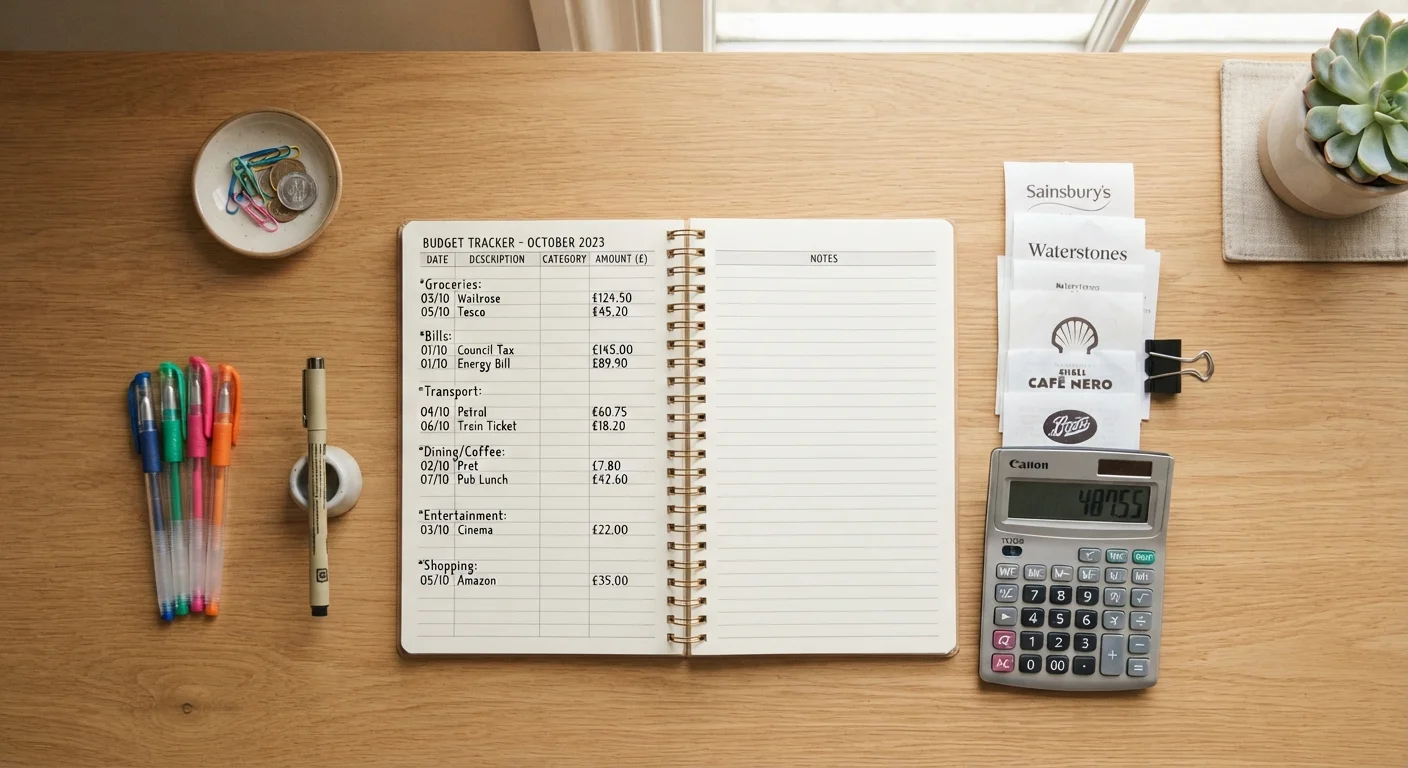
You don't need specialized software to build a functional budget. What you do need is honest data and somewhere to organize it. Choose a tracking method that you'll actually use - the right format varies by person.
Bank or credit card statements
Reveals actual spending patterns across categories rather than estimated ones.
Spreadsheet or budgeting app
Organizes income and expense categories and tracks totals over time.
Calculator
Helps compute monthly averages for irregular and annual expenses.
For guidance on choosing between pen-and-paper, spreadsheets, and apps, see methods that stick.
Step-by-Step: Building the Budget
Work through each step in order. Skipping ahead - especially past the irregular expenses step - is where most budgets lose their accuracy.
Calculate your true monthly take-home income
Begin with the money that actually lands in your bank account - after taxes, health insurance premiums, and any other payroll deductions. If you're paid biweekly, multiply one paycheck by 26, then divide by 12 to get a monthly figure. If your income varies, use a conservative estimate - either your three-month average or your lowest recent month. Overestimating income is one of the most common reasons first budgets collapse.
List every fixed monthly expense
Fixed expenses are the obligations that stay the same each month: rent or mortgage, car payment, insurance premiums, loan minimums, and any fixed subscriptions. Write each one down with its exact dollar amount. Total them up. This is your non-negotiable spending floor - the number your income must comfortably exceed before you plan anything else.
Convert irregular expenses into monthly line items
Irregular expenses - things like car registration, annual insurance premiums, holiday gifts, school supplies, or quarterly utility spikes - are where most budgets break down. Look back at your statements and identify every non-monthly charge from the past year. Add them all up, then divide by 12. That monthly figure becomes its own budget line, sometimes called a "sinking fund" contribution. You set that money aside each month so the expense doesn't feel like a surprise when it arrives.
Estimate variable essential expenses
Variable essentials are spending categories you can't eliminate but that fluctuate month to month - groceries, gas, utilities, and out-of-pocket healthcare costs. Pull your statements and calculate a three-month average for each. Use that average as your budget target. For categories that swing seasonally (heating bills in winter, cooling in summer), consider using a slightly higher average to build in a buffer. For a complete reference, see common household budget categories.
Allocate money for discretionary spending
After fixed costs, irregular savings, and variable essentials are covered, whatever remains can be allocated to discretionary categories: dining out, entertainment, clothing, hobbies, and personal care. Be honest rather than aspirational here. If your statements show $300 a month on dining out, budget $300 - or a deliberate reduction to $200 - rather than an unrealistic $50. Budgets built on wishful thinking tend not to survive contact with real life. The 50/30/20 rule can offer a useful starting framework for splitting needs, wants, and savings.
Build savings into the budget as a fixed line item
Savings should appear as a budget category - not as whatever is left over at month's end. Decide on an amount that is both meaningful and achievable given your current numbers, and treat it like a bill. This includes contributions toward an emergency fund. If you don't yet have one, starting with even a small monthly allocation matters more than the amount. For more on why this belongs inside your budget rather than outside it, see building an emergency fund inside your budget.
Balance the budget and check the math
Add up every category - fixed expenses, irregular monthly contributions, variable essentials, discretionary spending, and savings. Subtract the total from your take-home income. If the result is zero, you have a zero-based budget, where every dollar has a purpose. If it's negative, you're overspending on paper and need to trim categories before the month starts. If it's positive, decide consciously where that surplus goes - don't leave it unassigned or it tends to disappear. Use the monthly budget reset checklist to revisit these numbers at the start of every new month.
Treat Your Budget as a Living Document
No budget survives the first month perfectly intact - and that's expected, not a failure. The goal isn't perfection; it's adjustment. When a category runs over, note why and update the number for next month. Budgets that adapt to real behavior are far more useful than ones that demand ideal behavior.
This article provides general financial education and is not personalized financial advice. Consider consulting a licensed financial professional for guidance specific to your situation.
Keeping the Budget Useful Over Time
A budget isn't a one-time document - it's a monthly practice. Life changes: income shifts, expenses appear, priorities evolve. Plan to revisit your budget at the start of each month, compare it to last month's actual spending, and adjust category targets where reality diverged from the plan.
Don't Skip the Irregular Expense Step
Irregular expenses are the single most common reason a working budget suddenly stops working. Car repairs, medical co-pays, vet bills, and annual renewals feel like surprises only because they weren't planned for. Building a monthly sinking fund contribution for these costs converts financial surprises into manageable, predictable line items.
If you're building toward longer-term financial stability - not just month-to-month balance - a realistic monthly budget is the foundation. For perspective on what that longer arc can look like, wealth-building on a middle income is worth reading alongside this guide.