
Why Standard Saving Advice Doesn't Fit Variable Income
Most mainstream saving advice assumes a predictable paycheck - a fixed amount deposited on the same date every two weeks. For freelancers, gig workers, commission earners, and seasonal employees, that framework simply doesn't hold. When your income swings from $1,800 one month to $5,200 the next, rules like "save $500 per month" create confusion and guilt rather than progress.
The challenge isn't willpower - it's structure. As explored in the real reasons most Americans struggle to save, behavioral and structural factors matter far more than motivation. Variable earners need a system designed around irregular cash flow, not one retrofitted from salaried assumptions.
The good news: the core goal - spending less than you earn and consistently setting money aside - is completely achievable on an unpredictable income. It just requires a different set of tools.
Best Practices for Saving When Income Fluctuates
These approaches are designed specifically for income that doesn't arrive on a fixed schedule or in a fixed amount.
Save by percentage, not by fixed dollar amount
A percentage-based approach scales automatically with your income, so you save more in strong months and less in lean ones without breaking your system. It removes the psychological pressure of hitting a fixed target during a slow period.
Establish a baseline income buffer before anything else
Without a cash cushion equal to one to two months of essential expenses, a slow income month can derail all other financial goals. The buffer acts as a shock absorber, letting you continue paying bills during gaps without going into debt.
Use separate accounts to prevent accidental overspending
When all money sits in one account, it's easy to overestimate what's available to spend - especially when a large payment arrives. Separate accounts for taxes, emergencies, and monthly spending create visible, functional boundaries.
Set aside taxes immediately, before spending anything else
Self-employed individuals and gig workers typically owe self-employment taxes plus income taxes with no withholding. Failing to reserve for this routinely leads to a painful - and often debt-inducing - tax bill. Treating taxes as the first "expense" of every payment avoids this entirely.
Define a "lean month" floor and adjust spending proactively
Knowing your lowest reasonable monthly income lets you set a spending plan that works even in slow periods. This prevents the trap of spending to your peak income and scrambling when earnings drop.
Capture windfalls with a pre-committed allocation rule
Large, unexpected payments - a bonus project, a high-commission month - are the primary wealth-building opportunity for variable earners. Without a predetermined rule, windfalls tend to evaporate into lifestyle spending. A rule like "50% to savings, 50% available" removes in-the-moment temptation.
For a broader framework on managing cash flow month to month, see budgeting on an irregular income.
Quick Wins You Can Implement This Week
You don't need to overhaul your entire financial life to start making progress. These actions are designed to generate momentum immediately.
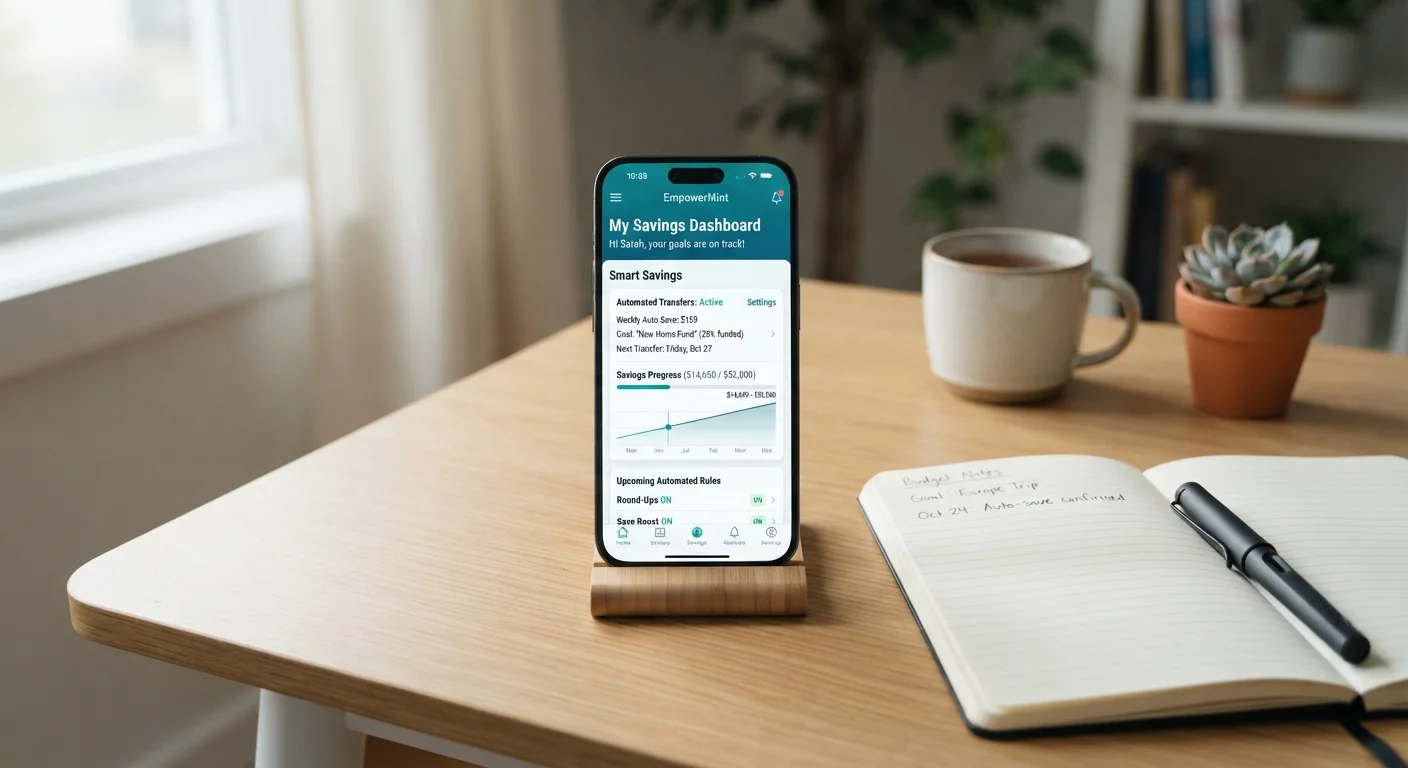
Once you have a savings habit in place, you may want to explore automating your savings - though the triggers will look different for variable earners than the standard monthly transfer.
Building Stability Over Time
Saving on a variable income is ultimately about creating artificial stability - building buffers and systems that smooth out the natural peaks and valleys of your earnings. The goal isn't to save the same amount every month; it's to save consistently as a proportion of what you earn, and to make sure windfalls don't silently disappear into lifestyle spending.
Track Your Income Trends Over Time
Keep a simple monthly log of your gross earnings - even a spreadsheet with one row per month works. After six months, patterns usually emerge: slow seasons, peak months, and a clearer income floor. This data is far more useful than guessing, and it feeds directly into smarter saving and spending decisions. Building a monthly budget that reflects real life offers a useful companion framework for putting that data to work.
Over time, as your income history grows, you'll have better data to set realistic savings targets and begin building toward longer-term goals. Whether you're starting from scratch or looking to accelerate, building a financial safety net from zero and what wealth-building actually looks like for middle-income households offer practical next steps.
This article is for general informational purposes only and does not constitute personalized financial advice. Consult a qualified financial professional for guidance specific to your situation.