
A Framework Built on Assumptions
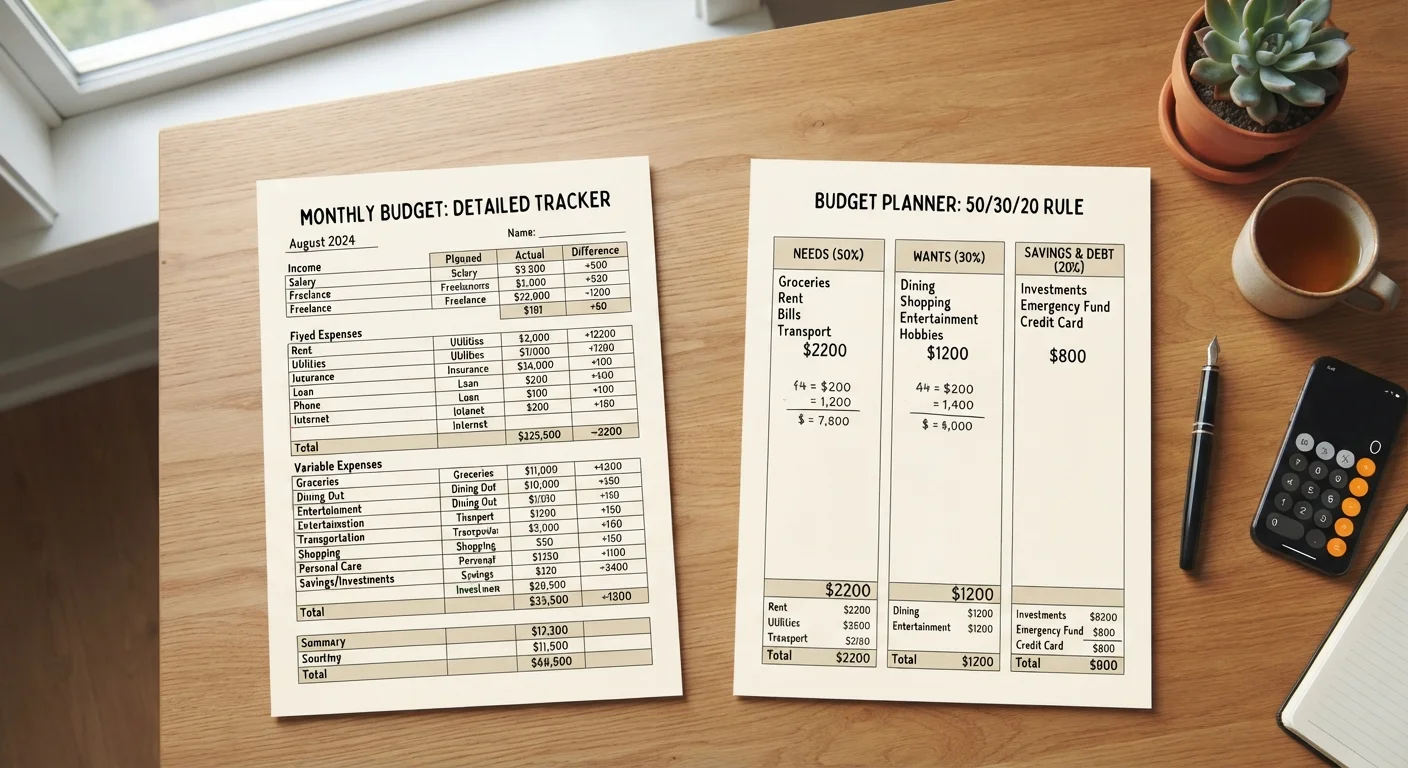
The 50/30/20 rule - 50% of after-tax income to needs, 30% to wants, 20% to savings and debt - is one of the most repeated pieces of budgeting advice in personal finance. It's appealing because it's simple. But simplicity has a cost: the rule rests on assumptions about income, housing costs, and spending that don't hold for a wide range of American households.
Understanding why the framework breaks down for some people is more useful than simply dismissing it. It helps you identify which parts apply to your situation and which parts need reworking. For a full breakdown of how the rule is designed to work, see The 50/30/20 Rule Explained.
Myth
The 50/30/20 rule works for anyone with a steady paycheck.
Fact
Income level and local cost of living determine whether the percentages are even mathematically achievable.
The rule assumes that after-tax income is large enough for needs to comfortably land at or below 50%. For someone earning $35,000 a year in a city where a one-bedroom apartment runs $1,500 per month, rent alone is nearly 51% of take-home pay - before any other need is counted. The formula isn't a universal law; it's a rough heuristic built around middle-income assumptions.
Myth
"Needs" and "wants" are easy to separate into two clear categories.
Fact
Many expenses fall on a genuine continuum, and what counts as a need varies significantly by job, health, family structure, and geography.
A car may be optional in a city with robust public transit but an absolute necessity for someone in a rural area where it's the only way to reach work. High-speed internet may feel like a luxury but is functionally required for remote workers. The 50/30/20 rule doesn't provide a framework for resolving these gray areas, which means two people following it sincerely can end up with very different category allocations - and neither is wrong.
Myth
Saving 20% of your income is always the right savings goal.
Fact
The appropriate savings rate depends on age, existing debt, retirement accounts, and financial goals - and 20% may be too high or too low depending on the individual.
Someone carrying high-interest debt may be better served by directing more than 20% toward repayment before building savings. A person in their 50s with minimal retirement savings may need to save significantly more than 20% to close the gap. Conversely, someone with an employer match already covering a meaningful retirement contribution may reasonably apply a different percentage. A fixed 20% target ignores these real differences.
Myth
If your budget doesn't fit the 50/30/20 mold, you're managing money poorly.
Fact
The rule is a starting-point tool, not a benchmark of financial competence. Many well-managed households operate on very different splits.
Evaluating financial health by how closely someone's spending matches a percentage formula misses the actual indicators of sound money management: living within your means, making consistent progress on goals, maintaining an emergency fund, and avoiding high-cost debt. These outcomes can be achieved with many different budget structures. Treating deviation from 50/30/20 as a sign of failure discourages people from budgeting at all - which is the worst outcome.
Where the Math Stops Adding Up
The most common point of failure is the 50% needs category. In many U.S. metro areas, rent alone can consume 40-50% of a moderate income. Add utilities, groceries, insurance, and transportation, and the "needs" bucket overflows before a single discretionary dollar is spent.
~30%
U.S. renters spending over half their income on housing
The Harvard Joint Center for Housing Studies has consistently found that around 30% of U.S. renter households are "severely cost-burdened," spending more than 50% of income on housing alone.
1 in 3
Americans with no emergency savings
Federal Reserve surveys on household economics have repeatedly found that roughly one-third of U.S. adults would struggle to cover an unexpected $400 expense - making a fixed 20% savings target unrealistic for a large share of the population.
For households earning below the median, needs routinely take up 65-80% of take-home pay. That leaves nothing for the 30% wants tier and compresses or eliminates the 20% savings goal entirely. Telling someone in that position that they're "doing the budget wrong" because their numbers don't match the formula is both inaccurate and unhelpful.
Freelancers and gig workers face a different problem: income that varies month to month. A percentage-based rule applied to an inconsistent income base produces wildly different dollar amounts each month, making consistent saving or spending plans hard to execute. Building a Monthly Budget That Reflects Real Life offers a more adaptable approach for variable earners.
Don't Force Numbers That Don't Fit
Stretching or misclassifying expenses to make your budget appear to match the 50/30/20 formula gives you false comfort, not financial clarity. If your real needs consistently exceed 50% of your income, acknowledge that honestly and build a budget that reflects your actual numbers. A budget based on reality - even an uncomfortable one - is more useful than one built to match a template.
Adjusting the Rule - or Replacing It
If the 50/30/20 framework doesn't fit, there are two practical paths: modify the percentages to match your reality, or adopt a structurally different method. Some budgeters use a 70/20/10 split, allocating more to needs while preserving a savings floor. Others prefer zero-based budgeting, which assigns every dollar a job rather than working from percentages at all. For a direct comparison of both approaches, see Zero-Based Budgeting vs. the 50/30/20 Rule.
The core principle that does hold across all methods: spend less than you earn, save deliberately, and track where your money actually goes rather than where you think it goes. Before abandoning any system, also consider whether common misconceptions are making budgeting feel harder than it is - Budgeting Myths That Keep People From Starting addresses several worth reviewing. And if a new budget tends to stall after the first few weeks, Why Budgets Fail in Month Two explains why and how to push through.
Explore the full range of practical strategies at the Budgeting Basics hub.
This article is for general informational purposes only and does not constitute personalized financial advice. Consult a qualified financial professional for guidance specific to your situation.