
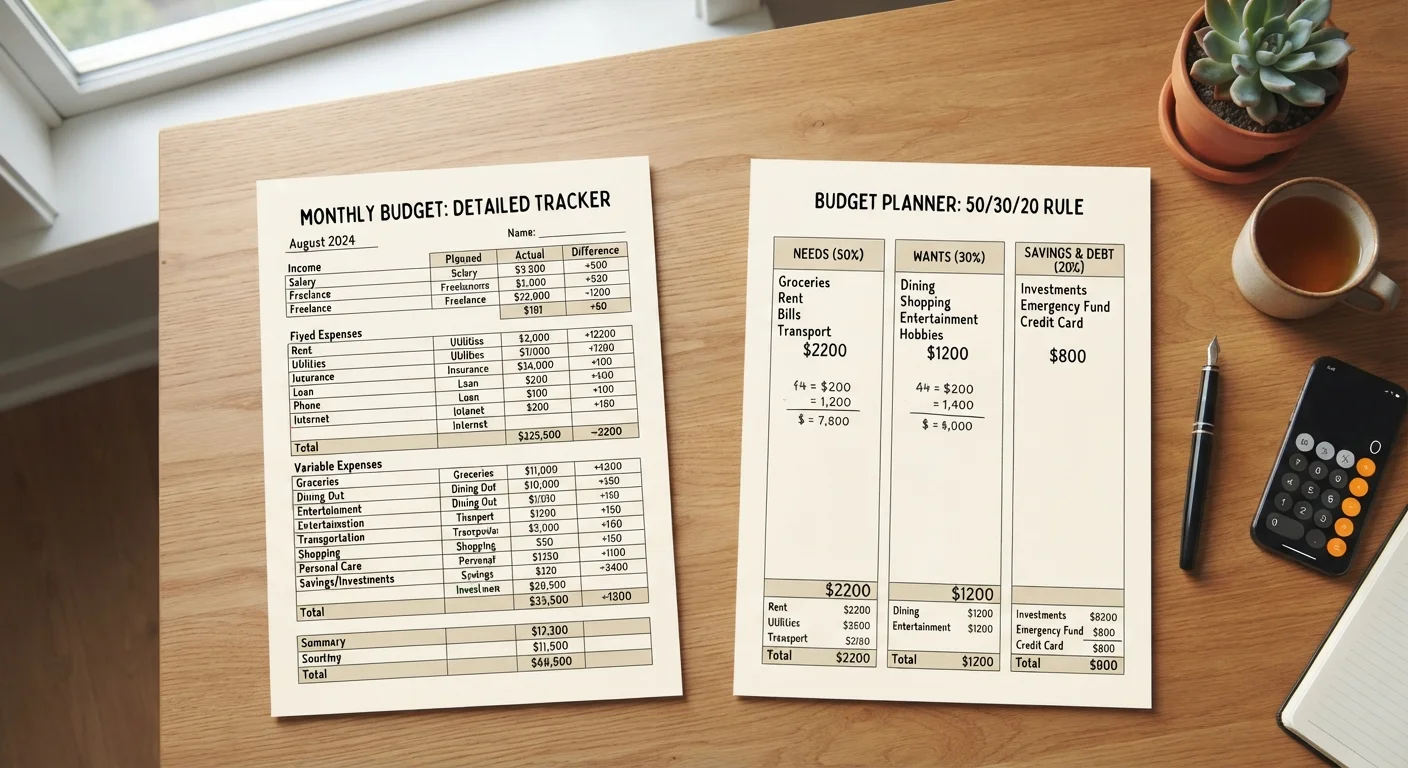
How Each Method Works
Understanding the mechanics of each approach makes the trade-offs much clearer.
Zero-based budgeting (ZBB) starts from zero every month. You list your total expected income, then assign every dollar to a specific category - rent, groceries, transportation, savings, entertainment - until income minus expenses equals zero. Nothing is left unassigned. If you earn $4,000 a month, every one of those 4,000 dollars gets a job before the month begins.
The 50/30/20 rule takes a different tack. It divides your after-tax income into three buckets: 50% toward needs (housing, utilities, groceries, insurance), 30% toward wants (dining out, subscriptions, hobbies), and 20% toward savings and debt repayment beyond minimums. On a $4,000 monthly income, that's $2,000 for needs, $1,200 for wants, and $800 for savings.
If you've never built a budget before, see our plain-language starting point for foundational steps before choosing a method.
| Criterion | Zero-Based Budgeting | 50/30/20 Rule |
|---|---|---|
| Core concept | Every dollar assigned a category | Income split into three percentages |
| Monthly time commitment | Higher - rebuilt each month | Lower - percentages stay fixed |
| Flexibility | High within each rebuild | High within broad buckets |
| Best income type | Variable or irregular income | Stable, predictable income |
| Detail level | Granular, category-by-category | Broad, three-bucket structure |
| Learning curve | Steeper - requires discipline | Gentle - intuitive to start |
| Debt paydown focus | Strong - dollars redirected precisely | Moderate - within the 20% bucket |
| Works in high cost-of-living areas | Yes - categories are fully customizable | Challenging - 50% may not cover needs |
Strengths, Weaknesses, and Real-World Fit
Zero-based budgeting's greatest strength is precision. Because every category is intentional, it tends to reveal spending habits that go unnoticed under looser systems - that streaming service you forgot to cancel, or the monthly amount quietly flowing into "miscellaneous." Research on household financial behavior consistently shows that awareness of spending patterns is one of the strongest predictors of improved saving rates. The drawback is time: rebuilding a detailed budget each month takes effort, and skipping even one month can undermine the system.
The 50/30/20 rule's strength is accessibility. Its simplicity lowers the barrier to starting, and the broad categories provide flexibility. However, it rests on assumptions - chiefly, that 50% of income is enough to cover needs - that don't hold in high cost-of-living areas or for lower-income households. For a fuller look at those limitations, see why the 50/30/20 rule doesn't work for everyone.
~33%
Americans with a detailed household budget
Gallup polling has consistently found that fewer than half of U.S. adults maintain a detailed household budget, suggesting most people use informal spending awareness rather than a structured method.
20%
Savings and debt target under 50/30/20
Financial educators commonly cite 20% of after-tax income as a useful savings-and-debt-repayment benchmark, though the right percentage varies widely by individual circumstance and goals.
Both methods also require honest categorization. Is a gym membership a "need" or a "want"? Reasonable people answer differently, and that ambiguity can distort either method if left unexamined.
Choosing, Combining, or Customizing Your Approach
The good news: these aren't the only two options, and they aren't mutually exclusive. Some people use the 50/30/20 rule as a high-level sanity check while applying zero-based logic inside their needs and savings categories. Others start with the 50/30/20 framework and migrate toward zero-based detail as their financial goals become more specific.
You might also consider how you prefer to track spending. A zero-based budget pairs well with spreadsheets or dedicated apps that support category-level tracking. The 50/30/20 rule can work with simpler tools - even a quick monthly calculation. Our guide on paper budgeting vs. spreadsheets vs. apps can help you match a tracking method to whichever system you choose.
If you're drawn to physical, category-by-category allocation, it's also worth exploring envelope budgeting, which shares zero-based budgeting's discipline in a tangible format.
Neither Method Is a Guarantee
Both zero-based budgeting and the 50/30/20 rule are frameworks, not financial guarantees. Their effectiveness depends on consistent follow-through and honest tracking. If one approach isn't working after a few months, that's data - not failure. Adjusting your method is a normal part of building a sustainable financial habit. See our article on common budgeting myths to avoid discouraging misconceptions before you start.
This article is for general informational purposes only and does not constitute personalized financial advice. Consider consulting a qualified financial professional for guidance tailored to your circumstances.