
The Needs vs. Wants Distinction (And Why It's Blurrier Than You Think)
Consumer education has long leaned on a simple split: needs are essentials, wants are extras. But lived purchasing decisions rarely sort that neatly. A reliable car is a need for someone commuting to work - but a specific model with heated seats edges into want. Groceries are a need; premium imported coffee is a want that feels essential by Tuesday morning.
The more useful framing isn't a binary but a spectrum. At one end sit non-negotiables tied to safety, health, and basic function. At the other are pure preferences - discretionary choices that reflect taste or aspiration. Most purchases land somewhere in between, shaped by context, habit, and how we've come to define "enough."
Needs
Items or resources required for basic functioning, safety, or health - things you genuinely cannot do without in a given context.
Wants
Goods or services that improve comfort, enjoyment, or status but are not strictly necessary for well-being or function.
Emotional trigger
An internal feeling - such as stress, boredom, or excitement - that increases the likelihood of making an impulsive or unplanned purchase.
Impulse purchase
A buying decision made quickly and without prior planning, often driven by in-the-moment emotion or environmental cues rather than deliberate intent.
Anchoring bias
A cognitive pattern where the first piece of price information you encounter disproportionately shapes your judgment of whether subsequent prices are reasonable.
Intentional spending
A deliberate approach to purchasing decisions that aligns spending choices with personal values and priorities rather than habits or external pressure.
Understanding where a given purchase sits on that spectrum requires knowing what it's actually doing for you - which is rarely just satisfying a physical requirement. That's where behavioral psychology becomes relevant. For a broader look at how emotions shape what we choose to buy, the documented patterns from behavioral economics offer a useful starting point.
How Emotional States Drive Purchase Decisions
One of the most consistent findings in consumer research is that emotional state at the time of shopping significantly predicts what - and how much - people buy. Stress, loneliness, boredom, and even celebration can all accelerate spending. Negative emotions in particular tend to shorten the mental gap between impulse and action.
This isn't a character flaw. It's a predictable feature of how the brain manages discomfort. Purchasing something new delivers a small, immediate dopamine signal, which temporarily eases distress. The problem is that the relief is short-lived, and the purchase persists. Over time, habitual emotion-driven shopping can quietly erode a budget.
Try the Emotion Check Before You Checkout
Before completing any unplanned purchase, take 60 seconds to name your current emotional state. Simply labeling it - "I'm stressed" or "I'm bored" - activates more deliberate thinking and often reduces the urgency you feel. This small habit interrupts the automatic path from impulse to transaction.
Understanding the role emotions play in consumer decisions - and developing strategies to respond differently - is a practical skill, not just an abstract concept. The goal isn't to eliminate emotional responses to shopping, but to recognize when they're doing the steering.
External Pressures That Shape What You Buy
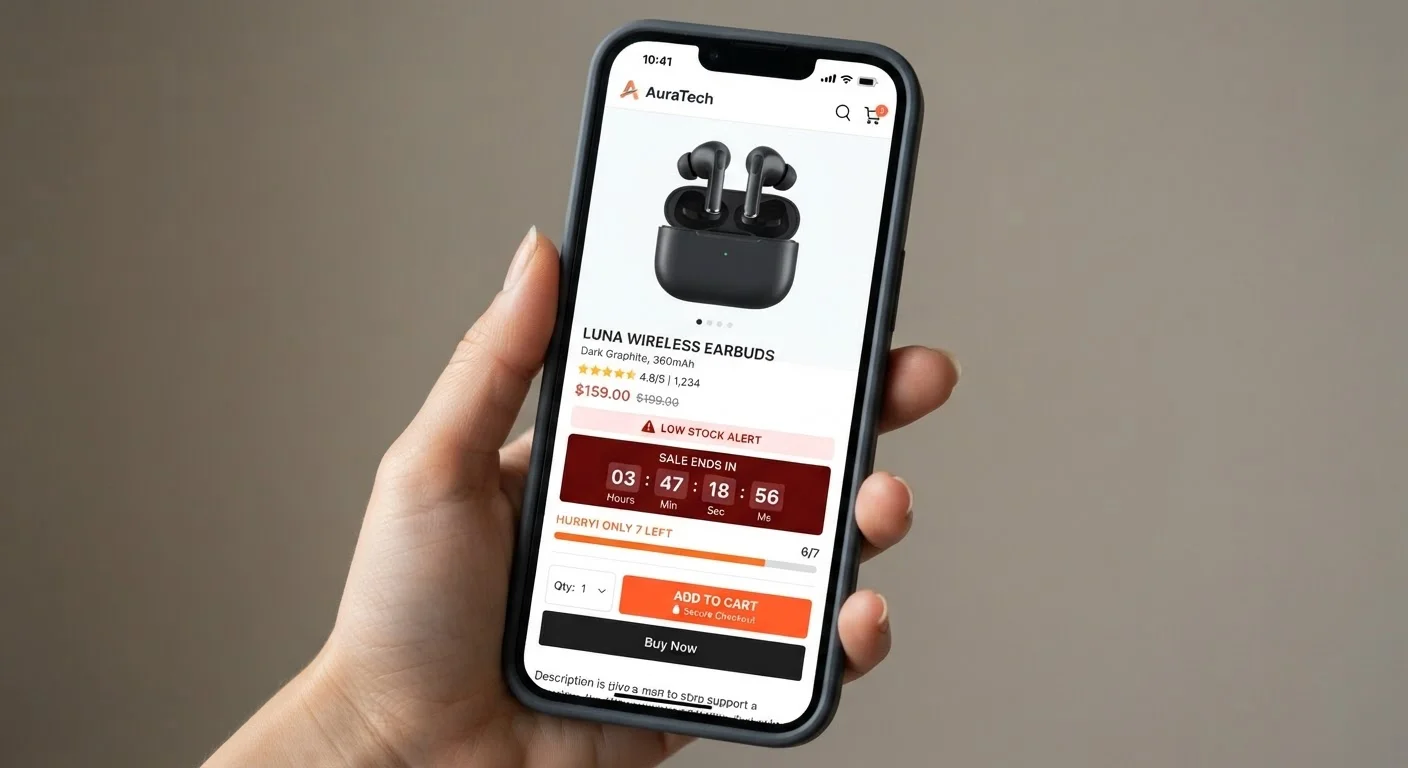
Emotional triggers are internal, but purchasing decisions are also shaped by forces outside your own psychology. Retailers design environments - physical and digital - to reduce deliberation and increase spending. Tactics like time-limited messaging, artificial scarcity signals, and social proof cues ("others are viewing this right now") exploit well-documented cognitive patterns. For a detailed breakdown of these techniques, see the explainer on how scarcity, social proof, and urgency shape purchasing.
Social context matters too. Peer spending norms, aspirational content on social media, and the subtle pressure of keeping pace with perceived standards all influence what feels like a want versus a reasonable expectation. These are not imaginary pressures - they are real inputs into decision-making that operate largely below conscious awareness.
Retailer Environments Are Designed to Reduce Hesitation
Both physical stores and e-commerce platforms are deliberately structured to minimize the pause between desire and purchase. One-click buying, pre-filled cart features, and countdown timers all reduce friction in ways that benefit the seller. Recognizing these design choices for what they are - deliberate persuasion tools - is the first step toward neutralizing their effect on your decisions.
Even the sequence in which you encounter prices affects your judgment. Anchoring bias - the tendency for the first price you see to set your reference point for value - means that the same item can feel like a bargain or an extravagance depending purely on context. Becoming aware of these external influences doesn't neutralize them entirely, but it creates meaningful resistance.
A Simple Framework for Pausing Before You Purchase
Intentional spending doesn't require rejecting every impulse. It requires inserting a moment of reflection between the trigger and the transaction. A few structured questions can do this reliably:
- What specific problem does this solve? If the answer is vague, that's useful information.
- What's my emotional state right now? Stress, boredom, or excitement shouldn't be the primary driver.
- Would I still want this tomorrow? The 24-hour test is a common and effective heuristic for separating impulse from genuine preference.
- Does this fit within my current spending priorities? For foundational tools on how to think through that, the Budgeting Basics hub offers practical frameworks.
These questions won't eliminate every regrettable purchase - and they're not meant to. Their purpose is to shift the ratio: fewer decisions made on autopilot, more made with enough awareness to reflect what you actually value. The approach you take before you shop - structured list or open browsing - also plays a measurable role in that outcome.
Building this habit over time connects to something larger than any individual transaction: aligning daily spending with the values and priorities that matter to you, not the ones the marketplace projects onto you.