Television as the Mirror of American Life
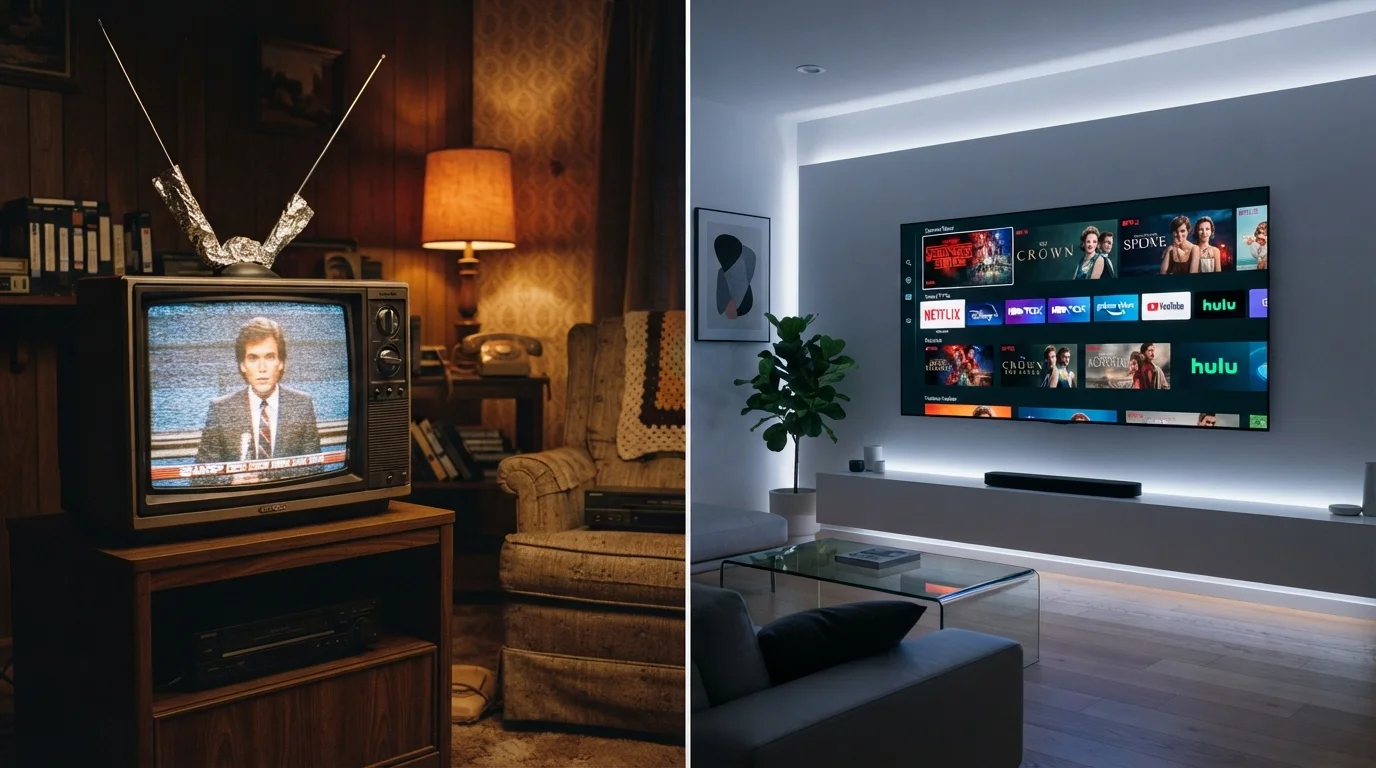
No medium has shaped - or reflected - American culture quite like television. From the earliest black-and-white broadcasts to the algorithm-driven streaming landscape, TV has repeatedly served as the place where the country gathered, argued, grieved, and laughed together. Certain moments transcended entertainment entirely, entering the permanent record of national experience.
This decade-by-decade look examines those inflection points: not just what happened on screen, but why each moment carried cultural weight far beyond its runtime. For a broader view of how these dynamics intersect with generational experience, see how different generations experienced American life.
The Moon Landing Broadcast (1960s)
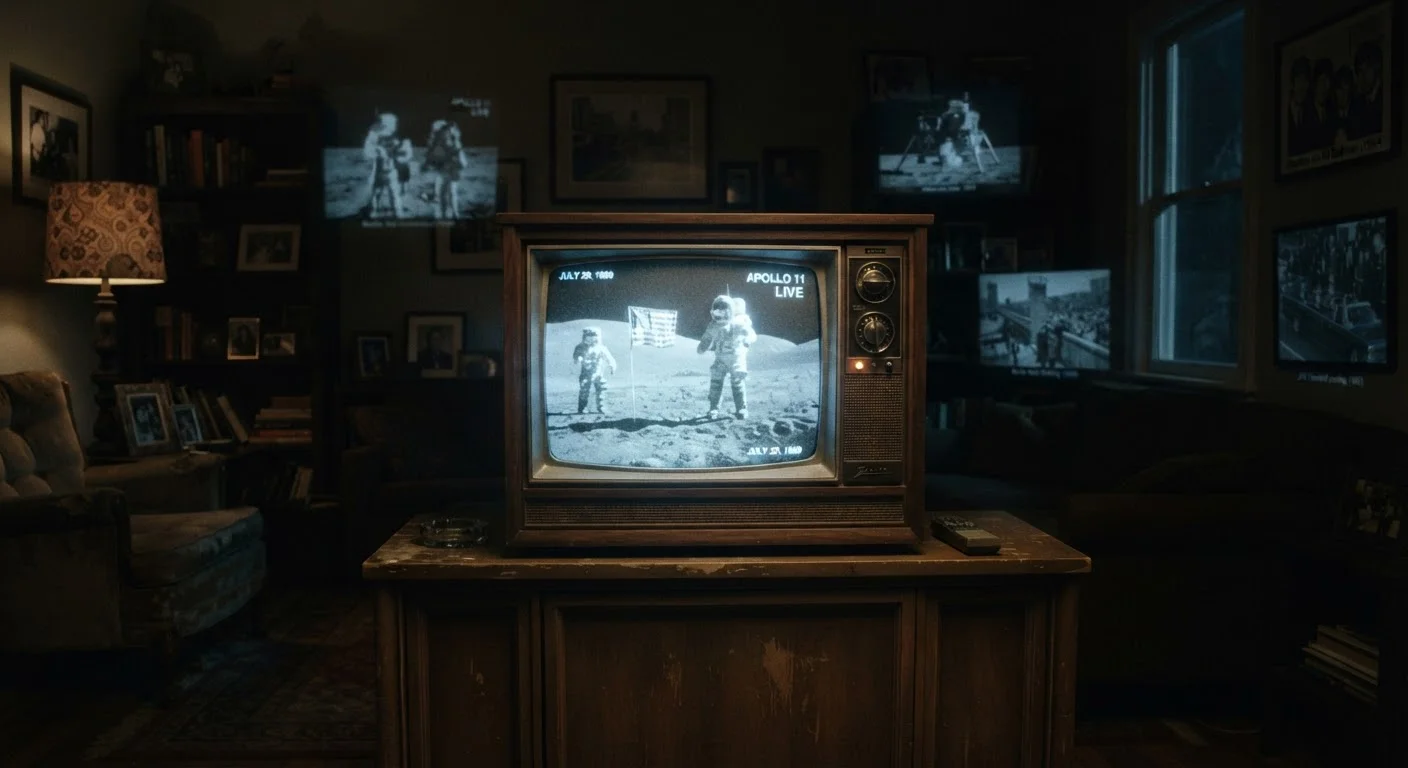
On July 20, 1969, an estimated 600 million people worldwide - including the vast majority of American households with televisions - watched Apollo 11 astronauts land on the moon. The grainy, live CBS broadcast anchored by Walter Cronkite became the defining image of postwar American optimism. Television had already covered the Kennedy assassination and civil rights marches, but the moon landing demonstrated the medium's unique power to transmit history in real time.
The 1960s established television as the primary venue for national reckoning, from political conventions to the Vietnam War footage that brought conflict directly into American homes.
The Apollo 11 broadcast proved television could transmit history - and national identity - in real time.
All in the Family Premieres (1970s)
When All in the Family debuted on CBS in January 1971, it shattered the comfortable consensus of American sitcoms. Archie Bunker's bigotry was played for laughs but designed to provoke discomfort, forcing audiences to confront racism, sexism, and generational conflict in ways prime-time television had systematically avoided. The show topped Nielsen ratings for five consecutive seasons.
The 1970s used the sitcom and the TV movie to process social wounds left open by the preceding decade - from Roots (1977), whose eight-part miniseries drew over 100 million viewers for its finale, to the Watergate hearings that preempted regular programming and kept Americans riveted to their screens.
Archie Bunker forced American living rooms to confront prejudice that polite society preferred to ignore.
The Final Episode of M*A*S*H (1980s)
The 1983 series finale of M*A*S*H, titled "Goodbye, Farewell and Amen," drew approximately 106 million viewers - a record for a single television broadcast that held for nearly three decades. Set during the Korean War but widely understood as a commentary on Vietnam, the episode captured a national desire for closure that the actual end of the Vietnam War had not fully provided.
The 1980s also saw television's role in shaping politics grow unmistakably, from Ronald Reagan's mastery of the televised address to the rise of CNN as a 24-hour news presence following its 1980 launch - a development that permanently altered how Americans consumed political information.
The M*A*S*H finale drew 106 million viewers, demonstrating television's unmatched power to provide collective closure.
The O.J. Simpson Verdict (1990s)
On October 3, 1995, an estimated 150 million Americans stopped what they were doing to watch the live television broadcast of the O.J. Simpson murder trial verdict. Courtroom footage - made possible by California's decision to allow cameras in the trial - had already turned the proceedings into a months-long national drama. The verdict's announcement exposed deep racial divisions in American society, with surveys consistently showing Black and white Americans interpreting the outcome in starkly different ways.
The 1990s were also the decade of appointment television as a cultural force: Seinfeld, Friends, and ER commanded audiences in the tens of millions weekly, creating the last era of true mass-viewership programming before cable fragmentation accelerated.
The Simpson verdict broadcast laid bare racial divides that American television had rarely confronted so directly.
9/11 Coverage and The Sopranos Era (2000s)
The live television coverage of September 11, 2001 was, by nearly any measure, the most-watched news event in American broadcast history. Networks aired continuous, commercial-free coverage for days. The footage became seared into collective memory in a way that altered how Americans understood television's role as witness to catastrophe.
The decade also marked the emergence of what critics called the "Third Golden Age" of American drama. The Sopranos, The Wire, and Breaking Bad redefined narrative ambition on the small screen, attracting audiences who had previously reserved that engagement for film. The moral complexity of these anti-hero narratives sparked widespread cultural debate about what television was allowed to say - a conversation that continues in discussions about representation and perception in pop culture.
Post-9/11 television became both communal witness and, through prestige drama, a new arena for moral storytelling.
Game of Thrones, #MeToo, and the Streaming Rupture (2010s)
The 2010s produced no single moment that commanded a unified national audience the way earlier decades had, and that absence is itself the defining cultural fact. Streaming fragmented viewership even as social media created the illusion of shared conversation. Game of Thrones became the decade's closest equivalent to an appointment television phenomenon, with its final season (2019) generating record-breaking viewership alongside record-breaking backlash - a dynamic that illustrates how viral cultural moments now spread and fade.
Off screen, the #MeToo movement's acceleration in 2017 was amplified by television interviews, documentary exposés, and real-time social media commentary, demonstrating how broadcast and digital platforms now operate together to shape public discourse - part of a broader pattern explored in movements that reshaped American culture in the 21st century.
The 2010s proved that fragmentation itself had become American television's defining cultural condition.
Why These Moments Still Matter
What separates a defining television moment from ordinary programming is its capacity to anchor collective memory - to become shorthand for an era, an emotion, or a social rupture. Scholars of media and culture often point to shared live viewership as a key amplifier: when millions watch simultaneously, the event accrues a social energy that recorded or streamed content rarely replicates.
The Simultaneity Effect in Broadcast Television
Media researchers have long noted that the cultural weight of a television event is amplified when viewers experience it simultaneously. Live broadcasts of trials, disasters, or finales create a shared reference point that replays and on-demand viewing cannot fully replicate. This simultaneity effect helps explain why pre-streaming TV moments tend to occupy a more prominent place in generational memory than their streaming-era equivalents, even when streaming shows attract comparably large cumulative audiences.
The shift from broadcast to streaming has fundamentally altered this dynamic, as explored in the streaming era versus the broadcast era. Today, viral television moments tend to spread through social media clips rather than communal living-room viewing - a pattern that echoes how internet trends migrate from niche spaces to the mainstream. The mechanics differ, but the cultural hunger for shared moments endures.
Revisiting TV History With Critical Context
When exploring defining television moments, it helps to consider both the cultural context at the time of broadcast and the interpretations that have emerged since. A moment that appeared to unify audiences often concealed significant divisions - by race, class, region, or political identity. Approaching TV history with that dual lens produces a richer, more accurate picture of American life.