What Is a Meme, Actually?
The word meme predates the internet by decades. Biologist Richard Dawkins coined it in his 1976 book The Selfish Gene to describe cultural ideas that spread and replicate like genes - units of meaning passed from person to person through imitation. The internet didn't invent the concept; it massively accelerated it.
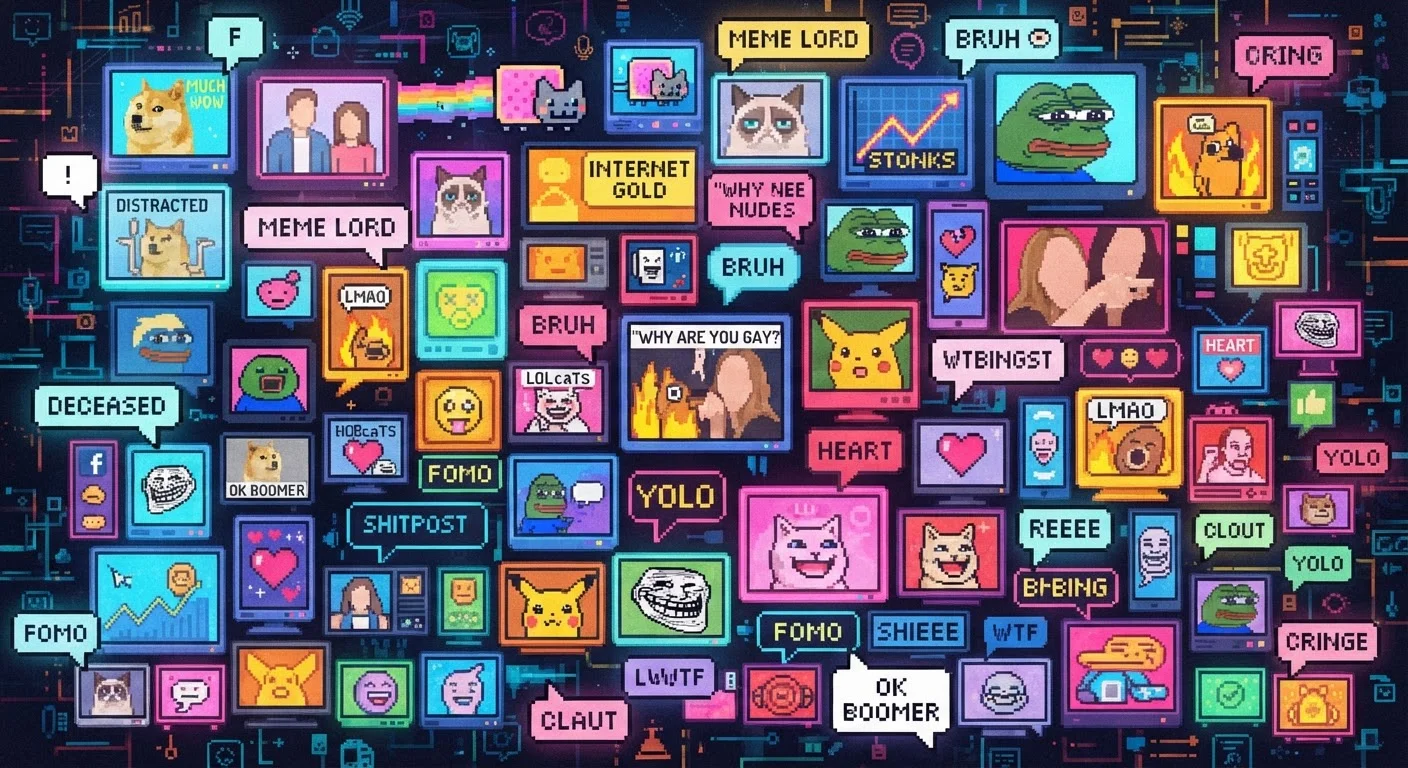
In everyday usage today, a meme typically refers to an image, video, phrase, or format that circulates online, gets remixed by users, and accumulates shared meaning over time. What distinguishes a meme from a simple joke is replicability: the same structural template gets applied to new situations repeatedly, each iteration adding context while referencing the ones before it.
That layering is what makes memes feel like a language rather than just entertainment. To understand them, you're often required to know the original source, why it resonated, and how successive communities adapted it.
Meme template
A recurring image, video, or phrase structure that users adapt by adding new captions or contexts. The template supplies shared visual or emotional shorthand.
Image macro
A photo or illustration overlaid with text, typically in a bold font. One of the most common meme formats online.
In-group signal
A reference or behavior that communicates membership in a particular community. Recognizing a niche meme functions as an in-group signal.
Remixing
Taking an existing cultural artifact - a meme template, a sound clip, a video format - and adapting it to a new context or meaning.
Lurking
Reading and observing an online community without actively posting. A common way to learn community norms and meme usage before participating.
Format fatigue
The point at which a meme template has been overused and loses its cultural resonance. Often accelerated when a format reaches mainstream advertising or news coverage.
The Anatomy of a Meme
Most image-based memes consist of two components: a template and a caption. The template - usually a photograph, illustration, or frame from a film or TV show - supplies the visual shorthand. The caption redirects that shorthand toward a new, specific situation.
Consider a well-known format: an image macro where a character expresses exaggerated distress. The template communicates emotional intensity through shared cultural memory. The caption anchors that energy to something topical - a work deadline, a sports outcome, a news event. The combination creates compressed meaning that would take far more words to convey literally.
Video memes and audio memes follow similar logic. A sound clip lifted from a movie, TV show, or viral moment becomes a shorthand reaction; users apply it to new video contexts. TikTok in particular has built much of its content architecture around this audio-template model.
For a closer look at why certain formats break through while others disappear, see The Anatomy of a Viral Moment.
How Memes Function as Social Signals
Beyond humor, memes serve as membership cards. Recognizing a meme - especially a niche or obscure one - signals that you belong to the community that produced it. Misusing or misunderstanding a format signals the opposite. This dynamic is why meme literacy carries real social stakes in certain online spaces.
Memes also compress shared emotional experience. During major cultural events - a presidential debate, a sporting upset, a celebrity statement - memes often become the primary medium through which collective reactions circulate. They're faster than op-eds, more portable than news articles, and carry emotional tone in a way plain text usually cannot.
Some formats are explicitly satirical, functioning as a kind of distributed political cartoon. Others are purely absurdist, with humor that resists literal explanation - a feature, not a bug, since the confusion it causes for outsiders reinforces in-group cohesion.
Observe before you post
If you're uncertain whether a meme fits a given community or moment, spend time reading how others use it before deploying it yourself. Most meme missteps come from applying a format without understanding the context it originally carried. A brief period of observation almost always prevents awkward misuse.
Understanding the unwritten rules that govern internet culture helps explain why meme misuse can generate genuine friction in online communities.
Where Memes Come From
The majority of durable meme formats trace back to communities on platforms like Reddit, Twitter/X, Tumblr, 4chan, Discord servers, and niche fan forums. These spaces develop their own idioms, inside jokes, and visual shorthand. When a format resonates beyond its origin point, it migrates - first to adjacent communities, eventually to mainstream platforms and sometimes news coverage.
That migration path matters because meaning can shift along the way. A format that originated with ironic intent in one community might be adopted sincerely elsewhere. Formats tied to specific political or subcultural identities can be recontextualized - sometimes deliberately, sometimes through simple unfamiliarity with origin.
This lifecycle - from niche origin to broad adoption to eventual oversaturation - is explored in depth in The Lifecycle of an Internet Trend.
Irony and sincerity can look identical
One of the more disorienting features of internet meme culture is that ironic and sincere uses of the same format can be visually indistinguishable. Context - the platform, the community, the timing - is what differentiates them. Without that context, even experienced meme readers occasionally misread the intent behind a post.
Reading Memes Without Missing the Point
Decoding an unfamiliar meme usually requires answering three questions: What is the original source? What emotion or idea does the template conventionally convey? And what specific twist is the caption adding?
Reference databases like Know Your Meme document the origins and evolution of thousands of formats, making them a practical starting point. Community wikis and subreddits dedicated to specific fandoms or platforms often provide more granular context for highly specific formats.
Lurking - reading without posting - before engaging in a new online space remains one of the most reliable strategies for building meme literacy organically. Observing how a community uses, subverts, and retires formats reveals far more than any glossary. For broader guidance on entering new spaces respectfully, see Navigating a New Online Community Without Putting Your Foot in It.
The goal isn't to catalog every meme in circulation - an impossible task - but to understand the mechanics well enough to read context and adapt. Fluency in internet culture, like fluency in any language, comes from engaged observation over time.
Know Your Meme
A community-maintained database documenting the origins, spread, and cultural context of thousands of meme formats. A reliable first stop for decoding unfamiliar references.
Reddit's r/OutOfTheLoop
A subreddit where users can ask about viral moments, trending phrases, and memes they don't understand. Answers are typically sourced and community-vetted.