Why Roundabouts Still Trip Drivers Up
Roundabouts have been expanding steadily across the United States for decades, yet they remain one of the most misunderstood features on American roads. Driver education programs historically gave them little attention, and many people learned to navigate them through trial, error, and a fair amount of honking.
The confusion isn't just an inconvenience - it creates real hazards. Wrong-way entries, failure to yield, and lane-choice errors are among the most common mistakes seen at roundabouts. Understanding what you're actually supposed to do makes the experience less stressful for everyone and keeps the intersection working as designed.
For a broader look at how US yield rules work in other situations, see our explainer on merging and right-of-way.
Myth
The car entering the roundabout has the right of way.
Fact
Entering drivers must yield to all vehicles already circulating inside the roundabout.
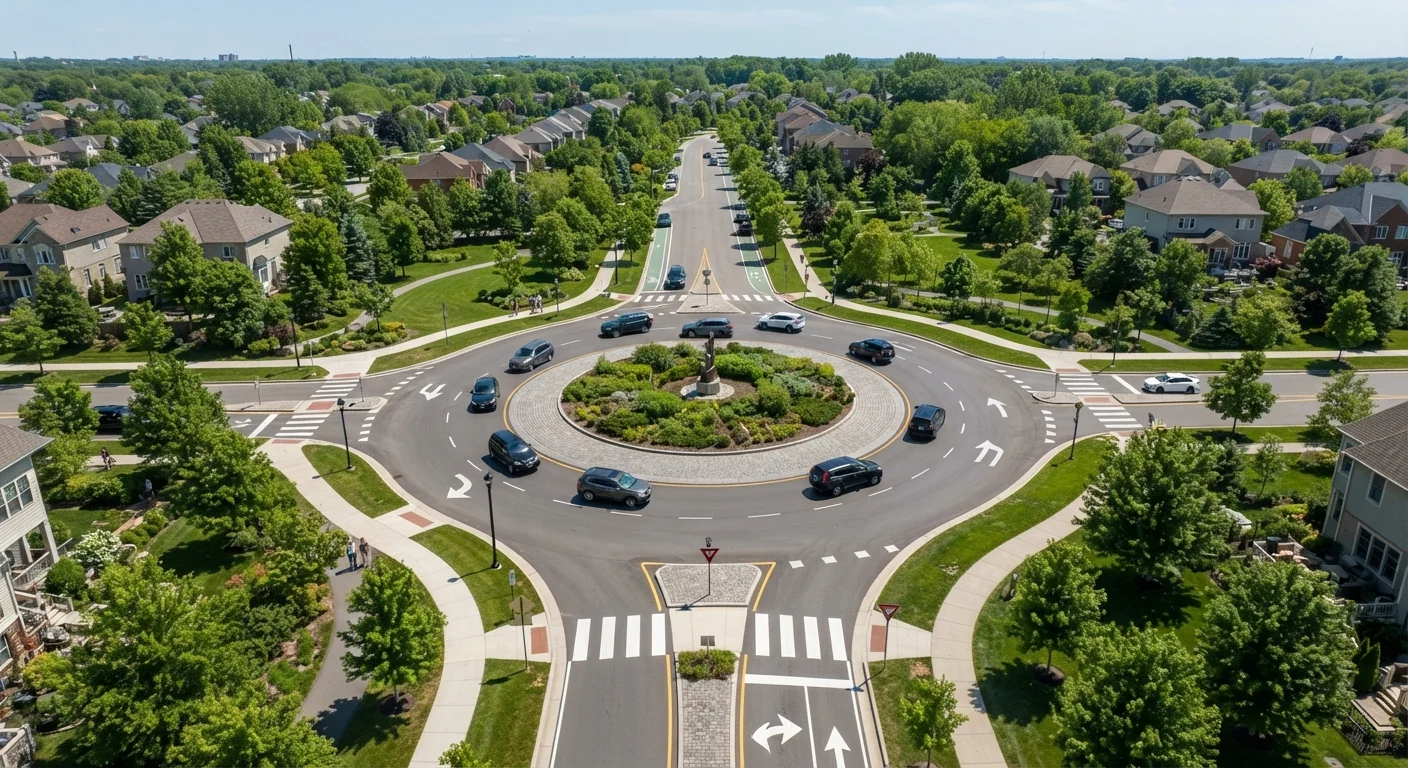
This is the single most dangerous misunderstanding about roundabouts. The yield sign at every entry point applies to you - the driver trying to enter. Vehicles already moving through the circle have the right of way. Pulling in front of circulating traffic as if you're merging onto a highway causes the majority of roundabout collisions. Wait for a clear gap, then enter.
Myth
You don't need to use your turn signal in a roundabout.
Fact
Signaling your exit helps other drivers and pedestrians anticipate your move - and is required in most states.
The common assumption is that because roundabouts flow continuously, signals don't matter. In practice, signaling your intended exit gives pedestrians at crosswalks and waiting drivers at entry points the information they need to act safely. A widely followed convention: signal right before your exit, just as you would when turning off any road. Check your state's driver handbook for the specific requirement where you live.
Myth
Roundabouts are only for one lane of traffic.
Fact
Many roundabouts have two or more lanes, each serving specific exit directions.
Multi-lane roundabouts work similarly to multi-lane regular intersections. As a general rule, use the right lane for exits up to and including the first right turn or a straight-through exit, and the left lane for exits that require going more than halfway around the circle. Guidance varies slightly by design, so signs and road markings at each specific roundabout take precedence. Making a lane change while inside the roundabout is both dangerous and typically prohibited.
Myth
You should stop inside the roundabout to let other cars in.
Fact
Stopping inside a circulating roundabout disrupts traffic flow and creates rear-end collision risk.
Once you're in the circle and moving, keep moving. The entire system depends on continuous flow. If you stop to wave in a waiting driver, the cars behind you - who aren't expecting a stop - may not have time to react. The entering driver is responsible for finding their own gap. Being courteous is good, but in a roundabout, keeping consistent speed is the safer form of courtesy.
Myth
Roundabouts are more dangerous than regular intersections.
Fact
Research consistently shows roundabouts reduce serious injury and fatal crashes compared to stop- or signal-controlled intersections.
The perception of danger largely comes from unfamiliarity. Studies by the Insurance Institute for Highway Safety and the Federal Highway Administration have found that converting a traditional intersection to a roundabout typically reduces fatal and injury crashes significantly - largely because impact speeds and conflict angles are much less severe. Fender-benders can still happen, particularly at entry points, but the life-threatening crash types become far less common.
Myth
Large trucks and emergency vehicles can't use roundabouts.
Fact
Modern roundabouts are designed with a raised apron that accommodates large vehicles while keeping smaller cars in the proper lane.
Roundabout designers account for oversized vehicles through a feature called a truck apron - a slightly raised, mountable ring around the central island. Tractor-trailers, fire trucks, and other large vehicles can ride up onto this surface to complete their turn without leaving the paved area. Passenger cars, meanwhile, are discouraged from using it by the raised lip. Emergency vehicles treat roundabouts like any other intersection: traffic must yield and pull to the right where safe to do so.
What the Evidence Actually Shows
Many drivers avoid roundabouts purely out of unfamiliarity, assuming they're more dangerous or harder to navigate than a standard intersection. The data doesn't support that instinct.
~75%
Reduction in injury crashes
The Federal Highway Administration has reported that converting conventional intersections to roundabouts can reduce injury crashes by approximately 75 percent.
~90%
Reduction in fatal crashes
According to FHWA research, roundabouts are associated with roughly a 90 percent reduction in fatalities compared to traditional intersections with stop signs or signals.
7,000+
Roundabouts in the US
The number of roundabouts in the United States has grown from a few hundred in the 1990s to several thousand today, with new installations added annually.
The safety improvements stem largely from the geometry itself. Because all traffic flows in one direction at low speeds, the most deadly collision types - T-bone and head-on crashes - are nearly eliminated. Conflicts still happen, but they tend to be lower-speed, glancing impacts rather than direct strikes.
Road signs approaching roundabouts are standardized and worth understanding - knowing what each sign means helps you prepare well before you reach the entry point.
Pedestrians Always Have the Right of Way
Every entry and exit point of a roundabout includes a marked crosswalk, and pedestrians legally have priority there. Before entering or exiting the roundabout, check for people in or approaching the crosswalk and yield completely. This rule applies even when the circle itself is clear of other vehicles.