Why Shape and Color Come Before Words
American road signs aren't designed arbitrarily. The Federal Highway Administration's Manual on Uniform Traffic Control Devices (MUTCD) establishes strict standards for every sign's shape, color, and placement. The goal is simple: a driver should be able to understand a sign's general meaning before they're close enough to read its text - and even if the text is obscured by weather, glare, or damage.
Shape communicates category. Color communicates urgency or function. Together, they form a visual shorthand that experienced drivers process almost automatically. Understanding that system makes you a more alert, more confident driver on any road.
| Governing standard | MUTCD (Manual on Uniform Traffic Control Devices) (Federal Highway Administration) |
| Number of distinct sign colors | 8 standardized colors (FHWA MUTCD) |
| Shape reserved for STOP signs | Octagon - used exclusively for STOP (FHWA MUTCD) |
| Warning sign shape | Diamond (FHWA MUTCD) |
| School zone sign shape | Pentagon (five sides, point up) (FHWA MUTCD) |
| Color for construction zones | Orange (FHWA MUTCD) |
Planning a longer drive? Our interstate road trip guide covers what to expect on extended highway routes where sign literacy really matters.
What Each Shape Signals
Sign shape is the first layer of meaning - one you can read from farther away than any text or color.
MUTCD
The Manual on Uniform Traffic Control Devices, published by the Federal Highway Administration. It sets national standards for all road signs, signals, and pavement markings in the US.
Regulatory sign
A sign that communicates a legal requirement drivers must follow, such as a speed limit or turn restriction. Typically white with black or red text.
Warning sign
A sign alerting drivers to a potential hazard or change in road conditions ahead, such as a sharp curve or pedestrian crossing. Usually diamond-shaped and yellow.
Guide sign
An informational sign helping drivers navigate - showing distances, highway numbers, exit ramps, or nearby services. Typically green, blue, or brown.
Fluorescent yellow-green
A high-visibility color introduced in the MUTCD to improve conspicuity for pedestrian, bicycle, and school zone warning signs, especially in low-light conditions.
- Octagon (eight sides): Reserved exclusively for STOP signs. No other sign uses this shape in the US, so even a faded or snow-covered octagon tells you to stop.
- Triangle (inverted, point down): Used only for YIELD signs. The downward point visually suggests giving way.
- Diamond: Warning signs. These alert drivers to upcoming hazards - curves, pedestrian crossings, animal crossings, merges.
- Rectangle (vertical): Regulatory signs that tell you what you must or must not do - speed limits, turn restrictions, lane controls.
- Rectangle (horizontal): Guide signs providing directional or informational content - distances, route markers, service locations.
- Pentagon (five sides, point up): School zone and school crossing signs.
- Crossbuck (X shape): Railroad crossing warnings.
- Circle: Advance warning of a railroad crossing or, on older routes, certain route markers.
Understanding merges and right-of-way situations becomes easier when you can quickly read regulatory sign shapes. See our explainer on US right-of-way rules for how these rules play out on the road.
What Each Color Means
The MUTCD assigns specific meanings to each sign color. Knowing these helps even when a sign's shape is ambiguous.
500+
Distinct sign types in the MUTCD
The Federal Highway Administration's MUTCD catalogs hundreds of standardized signs covering regulatory, warning, and guide categories.
8
Standardized sign background colors
The MUTCD specifies eight official sign background colors, each assigned a defined meaning to aid rapid driver recognition.
1935
Year the first national sign manual was published
The original Manual on Uniform Traffic Control Devices was issued in 1935, beginning the standardization of US road signs.
- Red: Stop, prohibition, or danger. Used on STOP signs, YIELD signs, DO NOT ENTER, and WRONG WAY signs.
- Yellow: General warning. The most common warning color - curves ahead, slippery when wet, pedestrian crossings, temporary construction warnings.
- Orange: Temporary traffic control and construction zones. If you see orange, expect changed conditions, reduced speeds, and workers potentially nearby.
- Green: Guide information - permitted movements, distance markers, highway route signs.
- Blue: Motorist services such as hospitals, gas stations, food, lodging, and rest areas.
- Brown: Recreational areas, parks, cultural sites, and scenic byways.
- White: Regulatory - rules you must follow, including speed limits and lane-use requirements.
- Fluorescent Yellow-Green: A newer high-visibility color used specifically for pedestrian, bicycle, and school zone warnings.
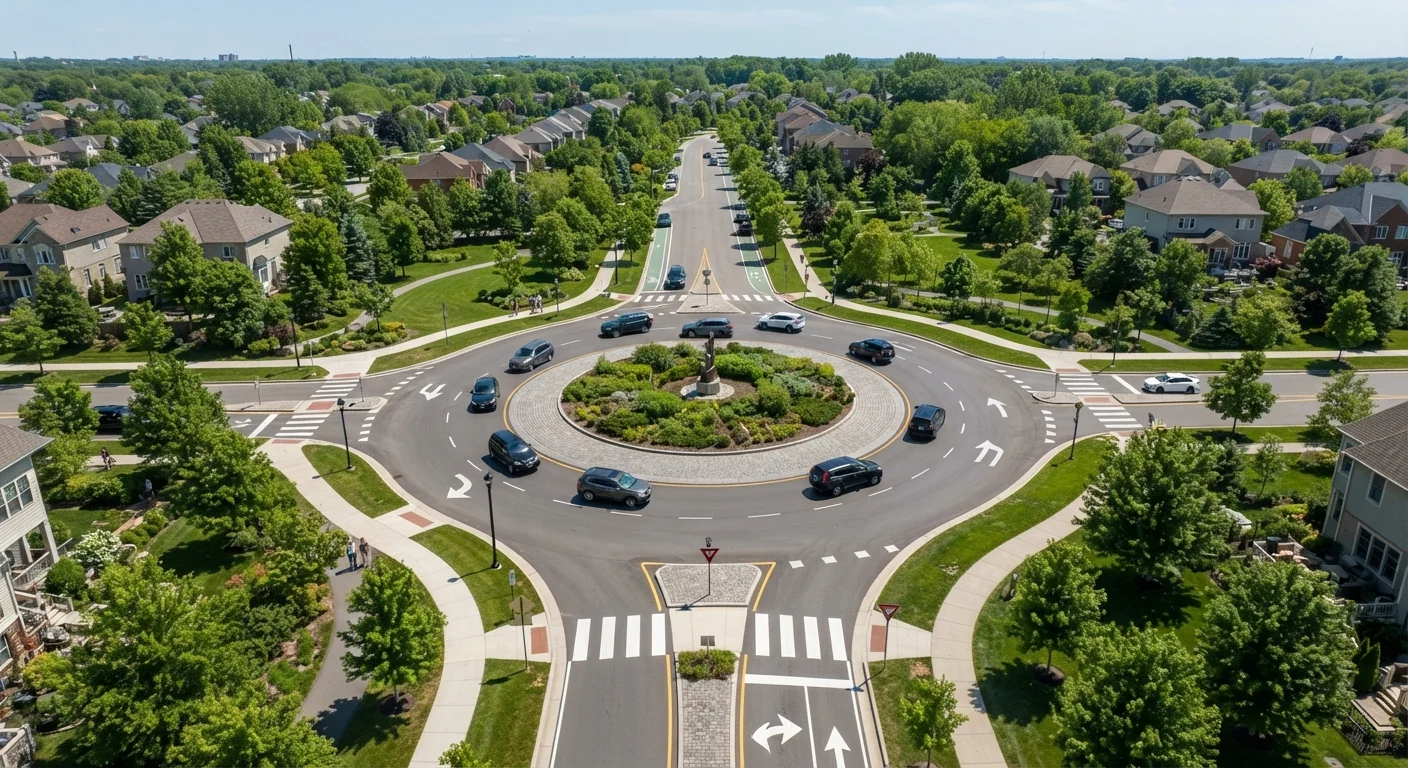
Roundabouts use a combination of warning diamonds and regulatory signs - a common source of confusion for drivers. Our article on what drivers get wrong about roundabouts clears up the most frequent mistakes.
Common Sign Categories at a Glance
Most signs fall into three practical categories. Keeping these buckets in mind helps when you encounter an unfamiliar sign.
- Regulatory signs (white/red, rectangular or octagonal): Tell you what the law requires. Compliance is mandatory.
- Warning signs (yellow or fluorescent yellow-green, diamond-shaped): Alert you to conditions ahead. They don't dictate action but call for heightened attention and adjusted speed.
- Guide signs (green, blue, or brown, rectangular): Provide information. Useful but not mandatory to follow.
Signs Can Vary Slightly by State
While the MUTCD sets federal standards, individual states have some latitude in supplemental signs, especially for local regulations and tourist attractions. Core regulatory and warning signs, however, must conform to federal standards nationwide. If you see an unfamiliar sign while traveling, the general color-and-shape system still applies and will give you a reliable first read of its meaning.
Staying alert to dashboard signals matters just as much as reading road signs. Our guide on dashboard warning lights explains what your car is trying to tell you.