
Why Borrowing Habits Matter Long-Term
For most Americans, debt is not optional - it's a practical reality. Mortgages, auto loans, student loans, and credit cards are woven into everyday financial life. The question isn't usually whether to borrow, but how to do it in a way that doesn't undermine your financial stability over time.
Responsible borrowing isn't a one-time decision. It's a set of habits and mental frameworks that you return to each time a credit decision comes up. The principles below have held up across different economic conditions precisely because they're grounded in straightforward math and behavioral consistency - not market timing or financial sophistication.
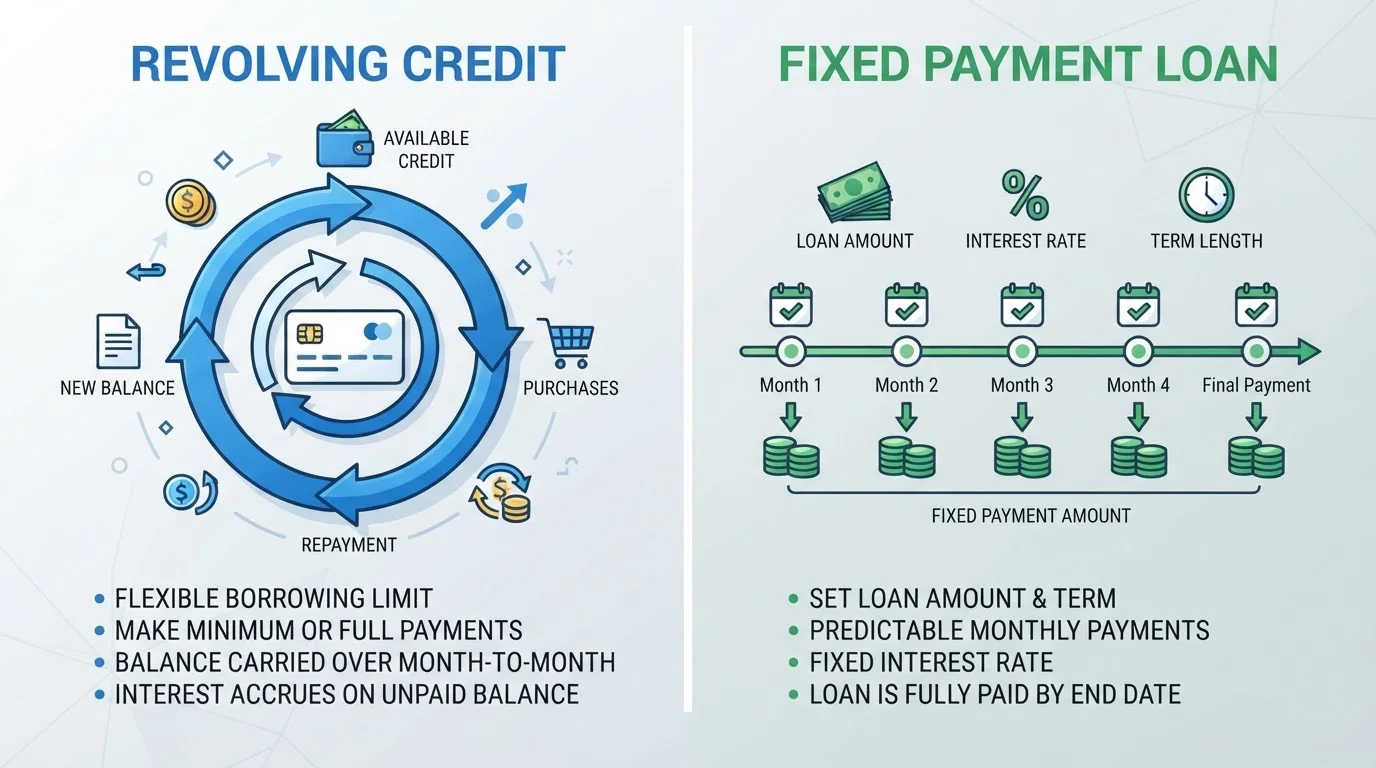
Understanding the difference between revolving credit and installment loans is a good place to start building that foundation.
Borrow only what your budget can realistically repay - not just what a lender is willing to offer.
Lenders approve loans based on their risk criteria, which don't always align with what's comfortable for your monthly cash flow. Stretching to the limit of what you qualify for can leave you financially fragile when unexpected expenses arise.
Always calculate the total cost of borrowing, not just the monthly payment.
Monthly payments are easy to focus on, but the real cost of a loan includes all interest paid over its life. A low payment spread across many years can cost significantly more than a higher payment on a shorter term.
Make on-time payments your non-negotiable baseline.
Payment history is consistently the most influential factor in most credit scoring models. A single missed payment can remain on a credit report for years and meaningfully lower a score that took time to build.
Keep revolving balances well below your available credit limits.
High utilization signals financial stress to lenders and scoring models, even if you're current on payments. Keeping balances low relative to your limits helps protect your score and your borrowing options.
Have a clear and specific purpose before taking on any new debt.
Debt without a defined purpose tends to linger. When you know exactly what the borrowing is for and how it fits into your overall financial picture, it's easier to stay committed to paying it off efficiently.
Review and understand any loan agreement before signing.
Interest rates, prepayment penalties, variable-rate clauses, and fee structures vary widely between lenders. Terms that seem minor at signing can become significant over the life of a loan.
Core Practices That Tend to Serve Borrowers Well
The practices below aren't complex. What makes them powerful is consistency - applying them across every borrowing decision, not just the big ones.
If you're weighing whether to put extra money toward debt or redirect it to savings, the debt vs. savings trade-off depends on interest rates, income stability, and your own situation - a decision worth thinking through carefully.
Keeping an Eye on the Numbers That Matter
35%
Weight of payment history in FICO scoring
According to FICO, payment history is the single largest factor in most credit score calculations, making consistent on-time payments the highest-leverage habit a borrower can build.
30%
Weight of credit utilization in FICO scoring
Credit utilization - how much of your available revolving credit you're using - is the second-largest factor in FICO scores, underscoring why keeping balances low matters even when payments are current.
One of the most actionable numbers to track is your credit utilization ratio - the share of your available revolving credit that you're currently using. Lenders and scoring models generally view lower utilization as a positive signal. Learn more about how utilization affects your credit score.
Debt-to-Income Ratio: A Key Benchmark
Your debt-to-income (DTI) ratio - total monthly debt payments divided by gross monthly income - is a figure many lenders evaluate when reviewing applications. A lower DTI generally signals more repayment capacity. While specific thresholds vary by lender and loan type, many conventional mortgage guidelines look for a DTI at or below 43%, though lower is usually preferable. Tracking your own DTI is a useful habit separate from whatever any lender requires.
It's also worth periodically reviewing your own borrowing habits against patterns that quietly erode credit over time. The habits that tend to damage credit aren't always obvious until the score has already slipped.
“Debt is a tool. Like any tool, its value depends entirely on how - and whether - it fits the job at hand. Used with intention and understanding, it can open real doors. Used carelessly, it quietly narrows your options.”
— Finance Editorial Team, Editorial commentary on personal borrowing principles
This article is for general informational purposes only and does not constitute personalized financial, investment, tax, or legal advice. Consult a qualified financial professional before making decisions about your specific situation.