
Why This Trade-Off Feels So Hard
When extra money shows up - a tax refund, a bonus, or simply a month where expenses ran low - the instinct to do the "right" thing financially can pull in two directions at once. Paying off debt feels responsible. Building savings feels responsible. Both are correct instincts, which is exactly what makes this decision genuinely difficult.
The tension isn't irrational. Debt carries a real cost in interest charges. But a savings account provides security that debt payoff alone cannot. Understanding what's actually at stake on each side is the first step toward making a choice you can stick with. For a broader look at how debt fits into your overall financial picture, the Debt & Credit hub covers the full landscape.
The Interest Rate Rule: Your Clearest Decision Tool
The most reliable framework for this trade-off is comparing your debt's interest rate against the return you could reasonably expect from saving or investing that money instead.
If your debt carries an interest rate of 10% or higher - common with credit cards - paying it down is almost always the stronger financial move. Eliminating a 20% APR balance delivers the equivalent of a guaranteed 20% return, which no savings account or low-risk investment can match.
On the other end, low-rate debt - federal student loans at 4-5%, or a mortgage locked in at a similar rate - presents a more genuine trade-off. Savings vehicles, particularly tax-advantaged retirement accounts over long time horizons, can reasonably be expected to outpace those rates. In that case, splitting your effort or leaning toward savings may make more sense mathematically.
| Factor | Prioritize Debt Payoff | Prioritize Savings / Investing | |
|---|---|---|---|
| Debt interest rate | High (above ~8-10%) | Low (below ~5-6%) | |
| Emergency fund status | Has a basic cushion already | No emergency fund in place | |
| Employer 401(k) match | Already fully captured | Not yet captured - fund first | |
| Income stability | Stable, predictable income | Variable or uncertain income | |
| Psychological impact | Debt causes significant stress | Building savings feels motivating | |
| Long-term math edge | Clear when rate > expected return | Clear when rate < expected return |
The gray zone tends to be debt in the 6-9% range. Here, the math is genuinely ambiguous, and personal factors - your risk comfort, income stability, and how heavily the debt weighs on you - should carry more weight.
Why an Emergency Fund Comes First - Even in Debt
One of the most common mistakes people make is eliminating savings entirely in order to attack debt faster. The problem: without a financial buffer, a single unexpected expense - a car repair, a medical bill - forces you to take on more debt, often at high interest, undoing your progress.
Most financial educators suggest keeping at least one to three months of essential expenses in liquid savings before aggressively redirecting money toward debt. Even a modest buffer of $500-$1,000 meaningfully reduces the risk of derailment. Our guide on building a financial safety net from zero walks through how to start, even on a tight budget.
Start Small With Your Emergency Buffer
You don't need three to six months saved before addressing debt. Even $500 to $1,000 in a dedicated savings account meaningfully reduces the risk of having to take on new high-interest debt when something unexpected happens. Build that baseline first, then shift your focus aggressively toward high-rate debt.
Once that cushion exists, you can direct extra dollars toward debt with much less risk of backsliding.
The 401(k) Match Exception
If your employer offers a 401(k) match and you're not capturing the full amount, that's typically the one savings priority that outranks even high-interest debt payoff. An employer match is an immediate 50-100% return on contributed dollars - a guaranteed gain that no debt payoff strategy can replicate.
The practical approach: contribute enough to your retirement account to capture the full employer match, then redirect remaining surplus dollars toward high-interest debt. This combination preserves a long-term wealth-building foundation while still attacking your most expensive liabilities. For more on how saving and investing work together, see the difference between saving and investing.
Psychological Factors That Matter More Than You'd Think
Personal finance isn't purely mathematical. Research consistently shows that people's ability to stick with a financial strategy depends heavily on how it feels - not just how it performs on paper.
Some people find carrying any debt deeply stressful, and the peace of mind from eliminating it is worth accepting a slightly lower mathematical outcome. Others feel energized by watching savings grow and are more consistent savers as a result. Neither response is wrong.
If you're weighing strategies for tackling multiple debts at once, the debt avalanche and debt snowball methods take both the math and the psychology into account. The best plan is one you'll actually follow.
Don't Let 'Good Debt' Labels Lower Your Guard
It's tempting to deprioritize debt labeled 'good' - like student loans or a mortgage - and redirect all extra income to savings. But even relatively low-rate debt has a real cost, and over-saving while carrying meaningful debt balances can mean paying more in interest than you're earning. Review the actual rate, not just the debt category, before deciding.
For those carrying multiple debt types, it also helps to revisit whether the good debt vs. bad debt distinction is shaping your priorities in ways that may not fully fit your situation.
Building a Workable Hybrid Strategy
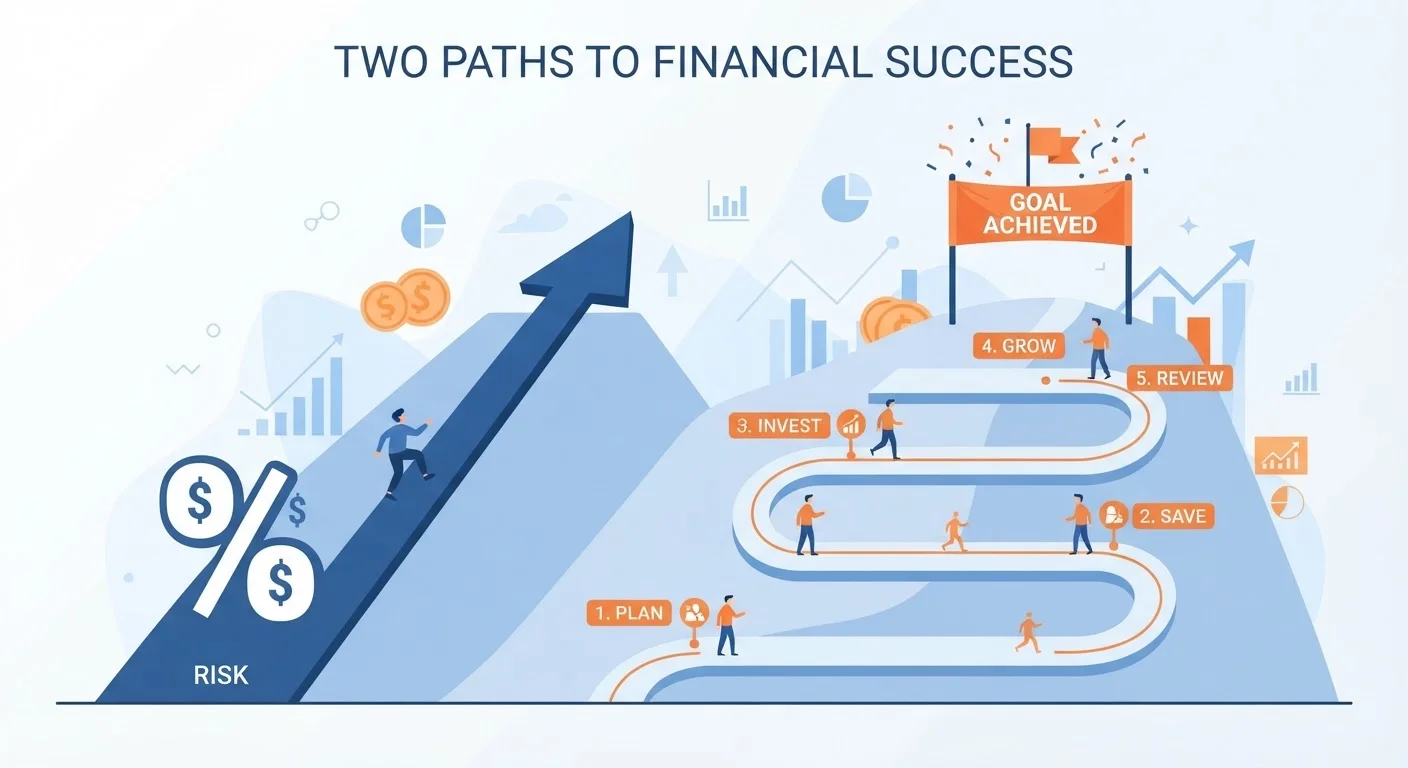
For most people, the answer isn't purely one or the other. A hybrid approach - directing a defined portion of surplus income toward debt and the rest toward savings - captures benefits on both sides without abandoning either goal entirely.
A common starting framework: after meeting minimum debt payments and capturing any employer match, direct the majority of remaining surplus toward whichever priority the interest rate comparison favors, while keeping a smaller flow going toward the other. The exact split is less important than consistency.
As your situation evolves - debt balances fall, income grows, savings reach a stable level - revisit the allocation. Financial priorities are not static. What wealth-building actually looks like for middle-income households offers a grounded perspective on how these decisions fit into a longer-term picture.
This article is for general informational and educational purposes only and does not constitute personalized financial, investment, or tax advice. Consult a qualified financial professional for guidance specific to your circumstances.