The Core Structural Difference
At the most fundamental level, revolving credit and installment loans differ in how money flows between borrower and lender. If you're new to these concepts, our plain-language introduction to borrowing is a useful starting point before going further.
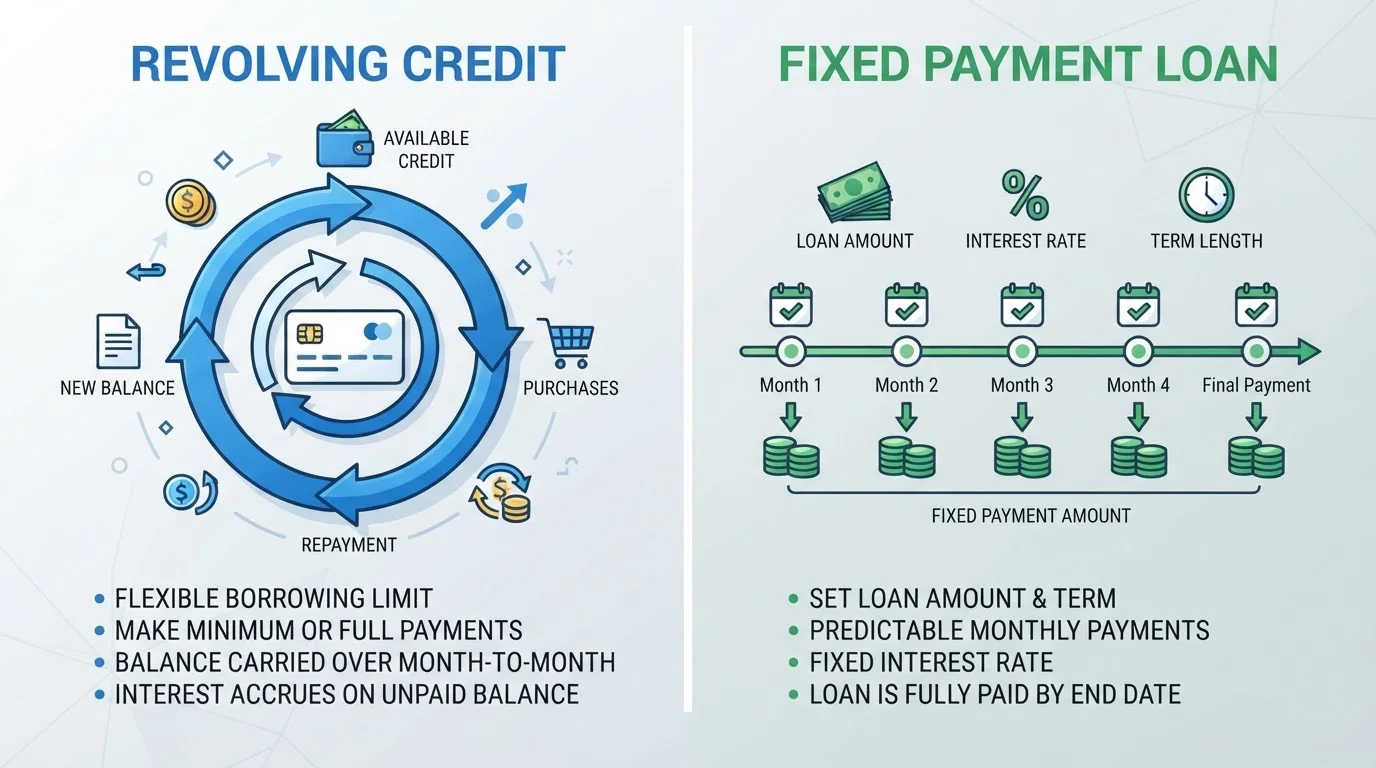
Revolving credit gives you a credit limit - a ceiling - and you can borrow up to that ceiling, repay some or all of it, and borrow again. The credit "revolves." Credit cards and home equity lines of credit (HELOCs) are the most common examples. Your minimum payment changes with your balance, and your available credit resets as you pay down what you owe.
Installment loans work differently. You receive a fixed lump sum upfront and repay it in equal, scheduled payments - called installments - over a set term. Auto loans, mortgages, personal loans, and student loans all follow this structure. Once you've repaid the loan, the account closes. To borrow again, you apply for a new loan.
| Criterion | Revolving Credit | Installment Loans |
|---|---|---|
| Structure | Reusable credit line up to a limit | Fixed lump sum, repaid over set term |
| Common examples | Credit cards, HELOCs | Auto loans, mortgages, personal loans |
| Monthly payment | Varies with balance | Fixed (typically) |
| Interest rate type | Often variable; high if balance carried | Usually fixed at origination |
| Credit utilization factor | Yes - significant score impact | No direct utilization ratio |
| Account lifecycle | Remains open; reusable | Closes upon full repayment |
| Best suited for | Variable, ongoing spending needs | Defined, one-time purchases |
The structural contrast matters because each type creates different obligations, different cost dynamics, and different effects on your credit profile.
How Interest and Costs Work
Understanding how interest accumulates on each type helps you anticipate real costs - not just the number on an offer letter.
With revolving credit, interest is typically charged on your average daily balance during the billing cycle. If you pay your full statement balance by the due date each month, many credit card issuers charge no interest at all - a grace period benefit that installment loans don't offer. Carry a balance, however, and interest compounds quickly; revolving credit tends to carry higher annual percentage rates than most installment products. For a deeper look at how APR is calculated, see our APR reference guide for borrowers.
Installment loans usually come with a fixed interest rate set at origination, meaning your rate - and therefore your monthly payment - doesn't change over the life of the loan. This predictability makes budgeting easier. Some installment products carry variable rates, but fixed-rate terms are the norm for consumer loans. The total interest you'll pay is largely determined upfront by the loan amount, rate, and term length.
~20%
Average credit card APR (approximate)
Federal Reserve data has consistently shown average credit card interest rates well above those of most installment loan products, highlighting the cost difference when balances are carried.
30%
Commonly cited utilization threshold
Credit scoring guidance frequently cites keeping revolving utilization below 30% of available credit as a general benchmark for healthier score outcomes, though lower is generally better.
One practical implication: revolving credit rewards disciplined, low-balance use. Installment loans reward you most by completing the full term without default or prepayment penalties.
Credit Score Implications
Both debt types appear on your credit report and influence your score, but through different mechanisms.
For revolving credit, credit utilization - the ratio of your current balance to your total credit limit - is a significant scoring factor. Keeping utilization low (commonly suggested below 30%, though lower is generally better) can positively affect your score. Maxing out revolving accounts, even temporarily, tends to lower scores noticeably. Installment loans have no utilization ratio in the same sense; what matters is your payment history and remaining balance relative to the original loan amount.
Payment history is the largest factor in most mainstream credit scoring models, and it applies equally to both types. Late or missed payments on either will hurt your score. On-time payments on either will help build it.
Credit mix - having both revolving and installment accounts - is also a recognized scoring factor, though it carries less weight than payment history or utilization. Lenders like to see that a borrower can responsibly manage different types of debt. This is one reason that responsible borrowing as a long-term practice often includes intentionally diversifying your credit types over time.
It's also worth noting that applying for new credit of either type generates a hard inquiry on your report. For more on that distinction, see how hard and soft credit inquiries affect your report differently.
Choosing the Right Structure for Your Situation
Neither type is universally superior - the better choice depends on what you're financing, how reliably you can budget, and what your credit goals are.
Revolving credit works well when spending amounts are variable or ongoing. A small business owner covering irregular supply costs, or a household managing intermittent home repairs, may find revolving credit more practical than repeatedly applying for installment loans. The risk is that open-ended access can make it easier to carry a growing balance.
Installment loans suit defined, one-time needs with a known total cost. If you know you need $12,000 for a home project, an installment loan with a fixed payoff schedule provides structure that a credit card's minimum-payment model doesn't. The pre-loan checklist for informed decisions can help you think through whether the loan term and total interest cost make sense before signing.
A related consideration is whether debt is secured or unsecured - which affects both the rate you're offered and the consequences of non-payment. Many installment loans (mortgages, auto loans) are secured by collateral, while most credit cards are not. Our article on secured vs. unsecured debt explains how that distinction shapes your obligations.
If you're already managing multiple debts of either type and looking for a repayment strategy, the debt avalanche and debt snowball methods offers a side-by-side framework.
This article is for general informational and educational purposes only and does not constitute personalized financial, tax, or legal advice. Consult a qualified financial professional for guidance tailored to your individual circumstances.