
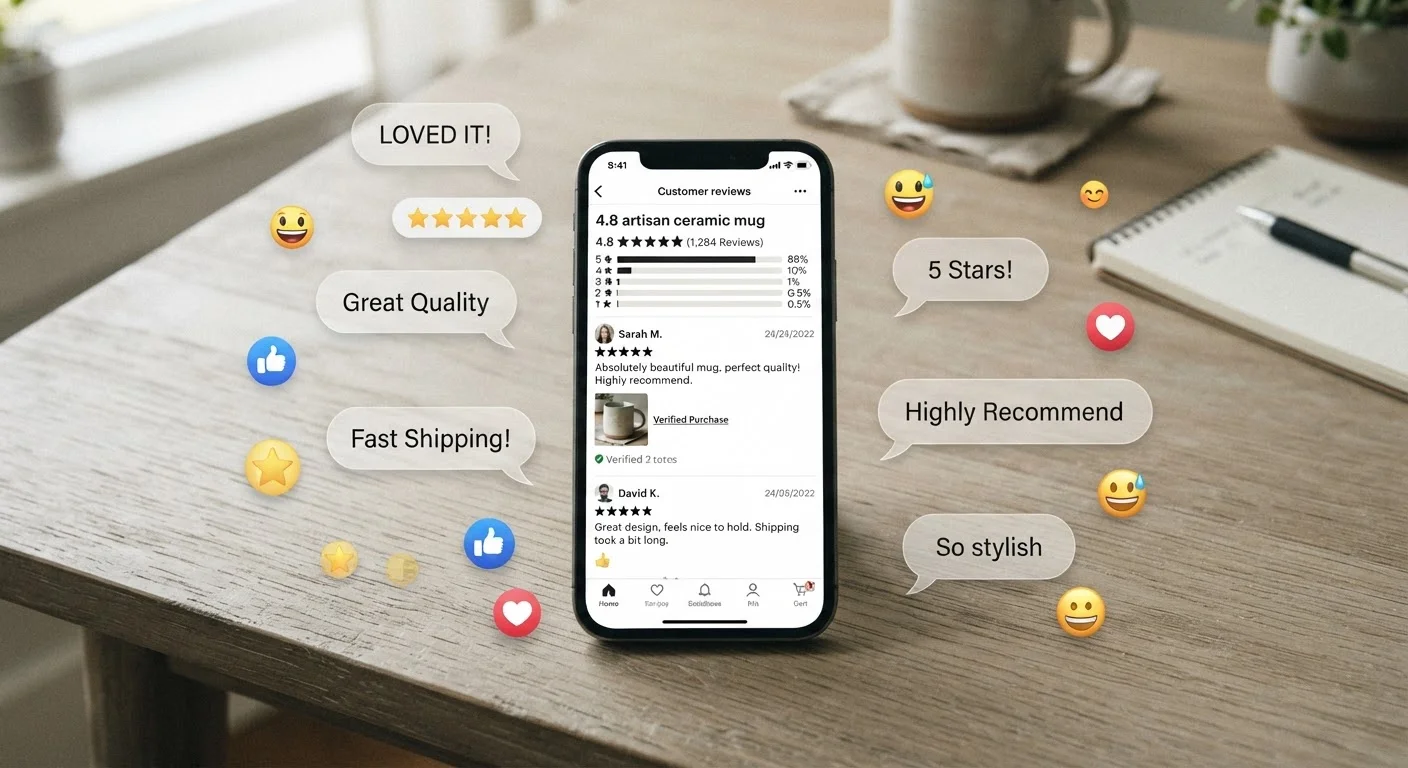
Why Ratings Aren't Pure Quality Signals
When a shopper glances at a 4.3-star average, the implicit assumption is that number reflects how well a product performs. In practice, it reflects something more complicated: the aggregate of dozens of human decisions made under varying emotional, social, and contextual pressures. Treating ratings as objective scorecards leads to predictable errors in judgment.
Consumer behavior researchers have documented for years that review scores are systematically influenced by factors entirely unrelated to product quality - from the mood a buyer was in when they opened the package to the design of the platform soliciting the review. Becoming a more informed shopper means understanding what those forces are and how to account for them. This is closely related to the broader skill of evaluating unfamiliar products across any category.
~82%
Shoppers who read reviews before buying
Multiple consumer survey studies have consistently found that roughly four in five online shoppers consult reviews before completing a purchase decision.
J-curve
Typical review distribution shape
Academic studies of online marketplaces find that review score distributions commonly cluster at 1-star and 5-star extremes, underrepresenting the moderate majority of experiences.
~30%
Lift in perceived trustworthiness with 50+ reviews
Consumer psychology research suggests review volume meaningfully increases shoppers' confidence in a rating's accuracy, with diminishing returns setting in beyond several hundred reviews.
The Psychology of Leaving a Review
Most purchases never receive a review at all. The customers who do leave ratings are self-selected, and that selection is rarely random. Motivation to review spikes at emotional extremes: delight and frustration are far more likely to produce written feedback than quiet satisfaction. This dynamic produces what researchers call a J-curve distribution - disproportionate clustering at both ends of the rating scale, with fewer reviews in the middle where most genuine experiences sit.
Timing also matters. A buyer who receives a damaged item and reviews it the same day is in a fundamentally different emotional state than one who writes a review after using a product successfully for three months. Platforms that prompt reviews immediately post-delivery capture a snapshot of unboxing emotion rather than long-term performance. Additionally, the well-documented psychological tendency toward expectation contrast means that a budget product that slightly exceeds expectations may outscore a premium product that met - but didn't exceed - higher expectations.
“Online ratings aggregate not just product experiences but the full context surrounding them - delivery speed, packaging, customer service, personal expectations. Treating the star score as a quality metric alone misses most of what actually determines it.”
— Itamar Simonson, Professor of Marketing, Stanford Graduate School of Business, and co-author of research on consumer decision-making
Platform Design and Structural Distortions
Review systems are not neutral infrastructure. The choices a platform makes - which reviews to display first, whether to round averages up or down, how prominently to feature summary scores, and whether to solicit reviews via automated email - all shape the data consumers see. A platform that prompts buyers after a positive shipping confirmation email will collect different ratings than one that prompts after a return request.
Incentivized review programs, where sellers offer discounts or gifts in exchange for reviews, remain a persistent issue on major marketplaces despite policy prohibitions. Even when sellers comply with the rules, early reviews from highly engaged customers (often brand enthusiasts) can inflate initial scores that persist long after a product's broader reception has normalized. For a deeper look at how data like this can be misread, understanding how to read consumer data is a useful companion skill.
Check the Review Date Range
When evaluating a product, filter reviews by the most recent 90 days rather than relying on the lifetime average. Manufacturing quality, product formulations, and seller practices can change over time, and older reviews may no longer reflect what you'll actually receive. A product with a strong historical score but poor recent reviews warrants more caution than the aggregate suggests.
Cultural and Social Influences on Ratings
Rating generosity varies across cultural contexts in ways that aggregate scores don't disclose. Cross-cultural consumer research consistently finds that shoppers from different national or regional backgrounds use rating scales differently: some reserve five stars for genuinely exceptional experiences, others treat them as a default acknowledgment of a satisfactory transaction. On global platforms, this variation folds silently into the average.
Social influence compounds the effect. Studies in information cascades show that existing ratings influence the scores new reviewers assign - people anchor partly on what others have said. A product with an early run of high scores benefits from a halo that a product launching with mediocre early reviews doesn't enjoy, even if underlying quality is equivalent. This is part of how shifting consumer values interact with perception: buyers who feel aligned with a brand's stated mission may rate its products more generously regardless of performance.
Reading Reviews More Effectively
Armed with an understanding of what distorts ratings, shoppers can adopt practical habits that extract more signal from the noise. Rather than anchoring on the aggregate score, look at the distribution histogram: a product with a 4.1 average driven by many 5-star and many 1-star reviews is a different proposition than one with a 4.1 driven by consistent 4-star feedback.
Sorting by recent reviews, reading the written text of middling scores, and filtering for verified purchases all reduce exposure to structural distortions. Pay attention to what reviewers criticize specifically - a pattern of identical complaints carries more diagnostic weight than a single scathing review. Developing this habit connects directly to the broader framework of smart shopping habits that lead to more informed purchasing decisions over time. Understanding ratings is ultimately one part of the larger project of separating marketing signal from genuine product information - a skill that also applies when understanding formal product grading systems.
Volume Matters, But Isn't Everything
A high review count reduces the distorting power of any single outlier, which is why a 4.2-star product with 2,000 reviews is statistically more informative than a 4.8-star product with 12. That said, volume alone doesn't correct for systematic biases like incentivized reviews or platform prompt timing - it simply dilutes random noise. Critical reading of review content remains essential regardless of count.