What Product Grading Actually Measures
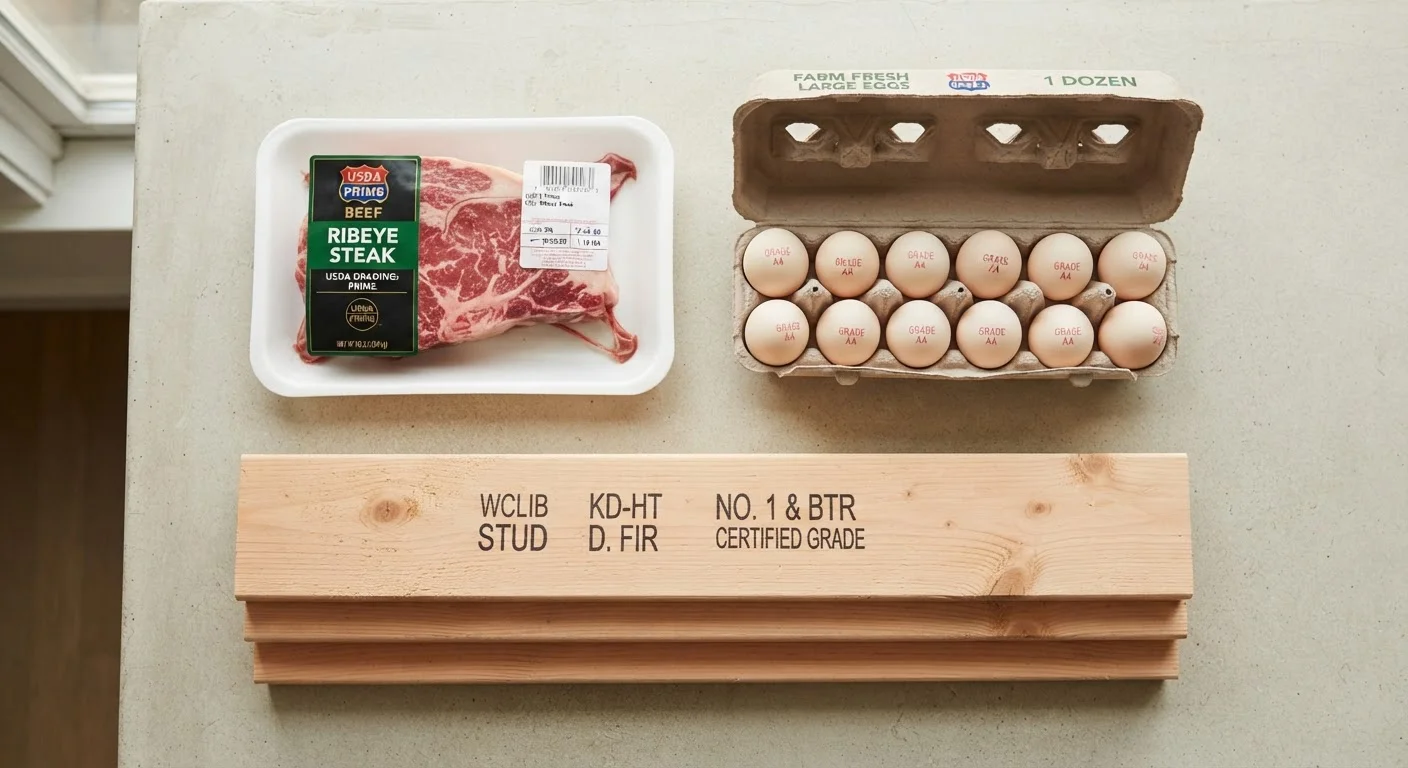
Walk through any grocery store or hardware supply and you'll encounter grades everywhere: USDA Prime beef, Grade A eggs, No. 2 common lumber. These labels suggest meaningful quality distinctions, but what they actually measure varies enormously by category - and misreading them can lead to both overpaying and underpaying.
Grading systems convert observable or testable product characteristics into a standardized shorthand. For beef, graders assess marbling (intramuscular fat) and maturity of the carcass. For shell eggs, they evaluate the condition of the shell, the firmness of the white, and the position of the yolk. For softwood lumber, structural graders assess knot frequency, grain straightness, and moisture content.
In each case, the grade reflects a snapshot of measurable traits at a specific point in the supply chain - not a comprehensive endorsement of the product's overall value to you.
~70%
Share of U.S. beef graded voluntarily
According to USDA Agricultural Marketing Service data, the majority of commercially slaughtered beef in the U.S. is submitted for voluntary quality grading by packers - but submission is not required by law.
3
USDA consumer-facing egg grade levels
The USDA shell egg grading program recognizes three consumer grades - AA, A, and B - each evaluated on shell condition, interior quality, and weight, based on USDA Agricultural Marketing Service standards.
Federal vs. Voluntary Grading Programs
One of the most important distinctions consumers rarely encounter is whether a grading program is mandatory or voluntary. In the United States, the USDA administers grading services for a range of agricultural commodities including beef, lamb, poultry, dairy, eggs, and certain fruits and vegetables. These programs exist, but participation by producers is typically voluntary - packers and processors request grading and pay for the service.
What this means in practice: a product carrying a USDA grade label has been evaluated by a trained federal grader against published criteria. A product without such a label may simply not have been submitted for grading - not that it failed.
Outside agriculture, grading is often entirely industry-administered. Lumber grades are set by standards organizations and enforced through mill certification programs. Diamond quality grades are assigned by gemological laboratories with no government role at all. Consumers encountering unfamiliar grade labels should ask: who issues this grade, and what criteria does it use?
Third-party certifications operate on a parallel but distinct track - they validate specific claims (sustainability, energy use, fair labor) rather than intrinsic quality characteristics, and are worth understanding separately.
Look Up the Grading Criteria Before You Buy
Most federal grading programs publish their full standards online through the USDA Agricultural Marketing Service or relevant agency. A quick search for the specific grade label you're seeing - plus the product category - will usually surface the actual criteria being measured. This takes two minutes and removes a lot of guesswork.
Lower Grades Aren't Always the Wrong Choice
Consumer instinct is to equate higher grades with better value, but that logic doesn't always hold. Grade distinctions are tied to specific criteria that matter for specific applications - and many lower-grade products are entirely appropriate for particular uses.
USDA Select beef, for example, has less fat marbling than Prime, making it less ideal for dry-heat cooking methods like grilling - but well-suited for braising, where moisture comes from the cooking liquid rather than the meat itself. Similarly, Grade B eggs (rarer in retail but common in food service) have thinner whites and flatter yolks - perfectly fine for baking, scrambling, or any preparation where appearance isn't the goal.
In lumber, a No. 3 common board has more knots and cosmetic variation than a No. 1, but it may be structurally sound enough for non-load-bearing interior applications. Paying for a higher grade than a project requires is a common and unnecessary cost.
Understanding what a grading criterion actually measures - not just where a product ranks - is the foundation of informed purchasing. For a broader look at how visual cues can mislead, see signals that are easy to mistake for durability.
Applying Grade Awareness When Shopping
Practical grade literacy starts with a simple habit: before assuming a grade label conveys what you think it does, identify the system behind it. A few questions help:
- What specific characteristics does this grade measure? Marbling, size, structural integrity, and optical clarity are all very different criteria.
- Who administers the grading program? Federal agency, trade association, or the seller themselves?
- Does the grade apply to my intended use? A grading criterion optimized for visual appearance may not predict functional performance.
This kind of thinking pairs well with assessing a product's build quality directly - grades tell you what standardized evaluators measured; your own inspection tells you what you observe. Neither alone is a complete picture.
For developing transferable habits across unfamiliar product categories, smart evaluation habits offer a useful framework beyond any single grading system.
Grades Reflect Condition at Time of Grading
A product graded at the processing facility may have experienced changes in handling, storage, or transit by the time it reaches a retail shelf. This is especially relevant for perishable items like eggs and produce, where grade standards describe quality under controlled conditions. Always combine grade awareness with your own sensory evaluation at point of purchase.