What Debt Actually Is
At its simplest, debt is money you borrow and agree to pay back, typically over a set period and with an added cost called interest. When a lender gives you a loan or approves a credit card, they're extending trust - they expect you to repay the full amount plus their fee for lending it.
Debt isn't inherently dangerous, but it does carry real obligations. Before borrowing anything, it helps to understand what you're agreeing to: how much you'll owe in total, when payments are due, and what happens if you fall behind.
Principal
The original amount of money you borrow, not including any interest or fees. Your payments reduce this balance over time.
Interest rate
The percentage of the principal a lender charges you each year for the use of their money. It determines how much extra you pay beyond what you borrowed.
Credit utilization
The share of your total available revolving credit that you're currently using. For example, a $500 balance on a $1,000 limit equals 50% utilization.
Hard inquiry
A check of your credit report triggered when you apply for new credit. It can temporarily lower your score and remains visible to lenders for up to two years.
Debt-to-income ratio
A measure of how much of your gross monthly income goes toward debt payments. Lenders use it to assess whether you can handle additional borrowing.
Default
What happens when a borrower fails to meet the repayment terms of a loan - typically after multiple missed payments. Default can trigger collections, legal action, and lasting credit damage.
Debt intersects directly with your broader money management. If you haven't yet mapped out your monthly income and expenses, the beginner's budgeting guide is a natural companion to this one.
How Interest Works
Interest is the cost a lender charges you for using their money. It's usually expressed as an annual percentage rate, or APR. On a credit card with a 20% APR, for example, carrying a $1,000 balance for a full year would add roughly $200 in interest charges - before accounting for any new spending.
Compound interest means interest is charged not just on the original amount you borrowed (the principal), but also on any unpaid interest that has already accumulated. This is why a small balance left unpaid can grow faster than it appears. Conversely, making payments above the minimum accelerates how quickly you reduce what you owe.
Use APR to Compare Borrowing Costs
When evaluating any credit offer, focus on the APR rather than just the advertised interest rate. APR bundles in most fees, making it a more accurate reflection of what you'll actually pay. A loan with a lower interest rate but high origination fees can end up costing more than one with a slightly higher rate and no fees.
Always compare the APR - not just the stated interest rate - when evaluating any loan or credit offer. APR includes most fees and gives a clearer picture of total borrowing cost.
Types of Debt You'll Encounter
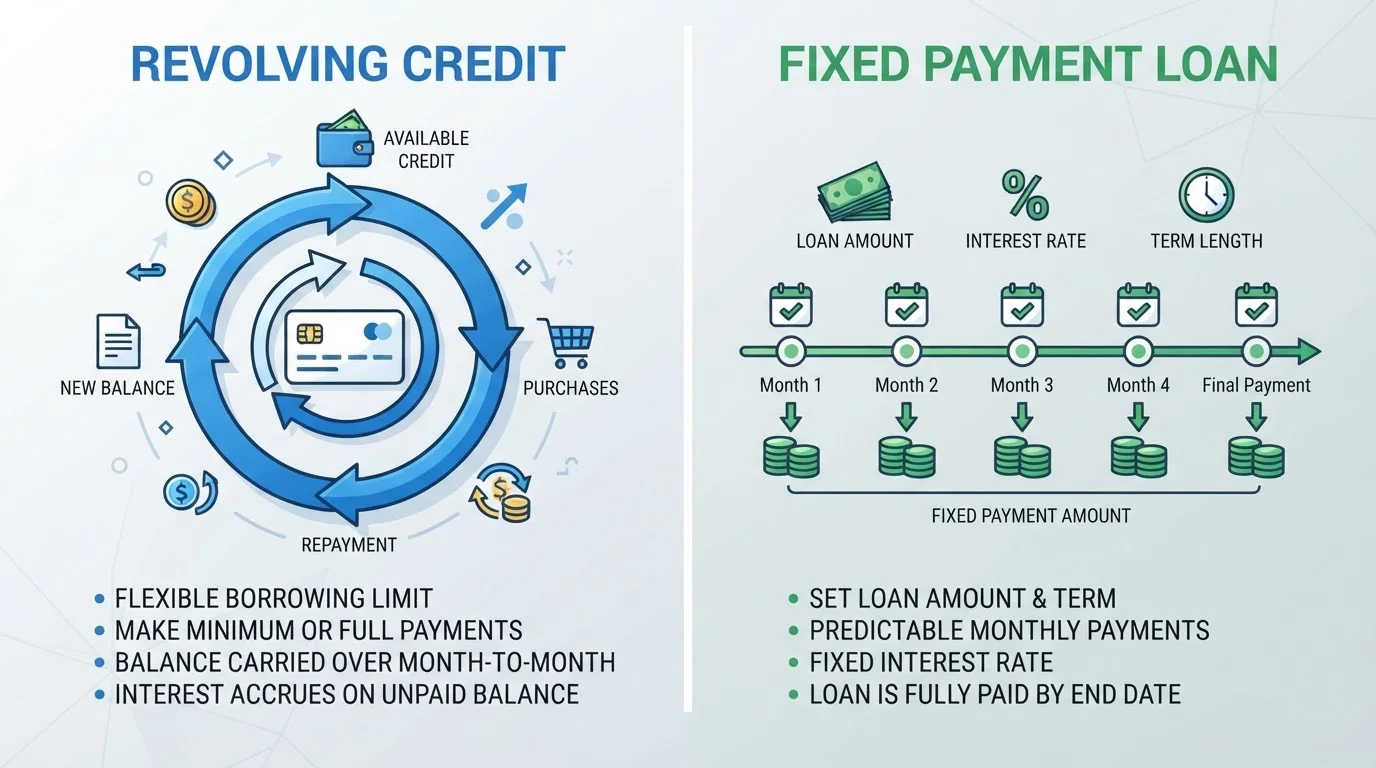
Not all debt is structured the same way. The two most common forms are installment debt and revolving debt.
- Installment loans have a fixed amount, a set repayment schedule, and a defined end date. Auto loans, student loans, and personal loans are examples.
- Revolving credit - like credit cards and lines of credit - lets you borrow, repay, and borrow again up to a set limit. Your balance and minimum payment fluctuate each month.
Understanding both structures matters because they affect your budget differently and play distinct roles in your credit profile. The guide to revolving vs. installment debt breaks down these differences in more detail.
Credit Scores: Why They Matter
A credit score is a three-digit number - typically ranging from 300 to 850 - that summarizes your history as a borrower. Lenders use it to decide whether to approve you for credit and at what interest rate. Higher scores generally translate to better terms and lower costs.
The factors that influence your score most heavily include:
- Payment history - whether you pay on time, every time
- Credit utilization - how much of your available credit you're currently using
- Length of credit history - how long your accounts have been open
- Credit mix - the variety of account types you hold
- New credit inquiries - how recently you've applied for new accounts
Your credit score also influences areas beyond borrowing - landlords, and in some cases employers, may review credit history as part of an application process.
Common Borrowing Mistakes to Avoid
First-time borrowers often run into the same avoidable pitfalls. Being aware of them early puts you in a much stronger position.
- Only paying the minimum: This keeps the account current but leaves the bulk of the balance - and ongoing interest - in place.
- Maxing out credit cards: High utilization (using most of your available credit limit) can pull your credit score down even if you pay on time.
- Applying for too much credit at once: Each application can trigger a hard inquiry, and several in a short period signals financial stress to lenders.
- Ignoring the fine print: Promotional rates, balance transfer fees, and penalty APRs are common surprises buried in the terms.
Don't Borrow Based on Monthly Payment Alone
Focusing only on whether you can afford the monthly payment can lead you to overlook the total cost of the loan - including years of interest. A longer repayment term lowers monthly payments but often means paying significantly more overall. Always calculate the total repayment amount before agreeing to any loan terms.
Some habits that seem harmless - like carrying a small revolving balance month to month - can quietly work against you over time. The article on subtle credit-damaging habits is worth reading once you're familiar with the basics.
Building a Foundation for Responsible Borrowing
Responsible borrowing isn't just about avoiding problems - it's about using credit as a deliberate financial tool. A few principles tend to hold up well over time:
- Borrow only what you can realistically repay given your current income and expenses.
- Understand the total cost of a loan - not just the monthly payment - before accepting any offer.
- Keep an emergency fund separate from any credit line so you're not forced to borrow for unexpected expenses.
- Review your credit reports periodically to catch errors or unfamiliar accounts. (All three major bureaus are required by federal law to provide a free report annually through AnnualCreditReport.com.)
Before taking on any new debt, it's worth working through a structured review of your situation. The pre-loan checklist offers a practical framework for doing exactly that.
If you want to go further, responsible borrowing as a long-term practice explores the habits and mindset that support a healthy credit life over years, not just months.
This article is for general informational and educational purposes only and does not constitute personalized financial, legal, or investment advice. Consult a qualified financial professional for guidance specific to your situation.