Why the Owner's Manual Is Your Most Reliable Source
There's no shortage of maintenance advice available to drivers - from quick-lube shop recommendations to online forums to well-meaning neighbors. But the most accurate source for your specific vehicle is the owner's manual that came with it. Manufacturers design maintenance schedules based on engineering data for that exact engine, transmission, and drivetrain. Generic advice may be close, but it's never as precise.
This matters most for intervals that vary significantly between vehicles. Oil change intervals, for example, can range from 3,000 miles to 10,000 miles or more depending on the engine design and oil type specified by the manufacturer. Following the wrong interval - in either direction - costs you money or, worse, shortens the life of your engine.
If you're new to car ownership and want a broader foundation, a complete beginner's overview of car maintenance is a useful starting point before digging into the specifics of your schedule.
Can't Find Your Physical Manual?
Most manufacturers provide a digital version of the owner's manual on their official website, searchable by year, make, and model. Your vehicle identification number (VIN) - found on a plate at the base of the windshield or on your registration - can help you locate the exact edition for your car.
What You'll Find in the Schedule - and How to Use It
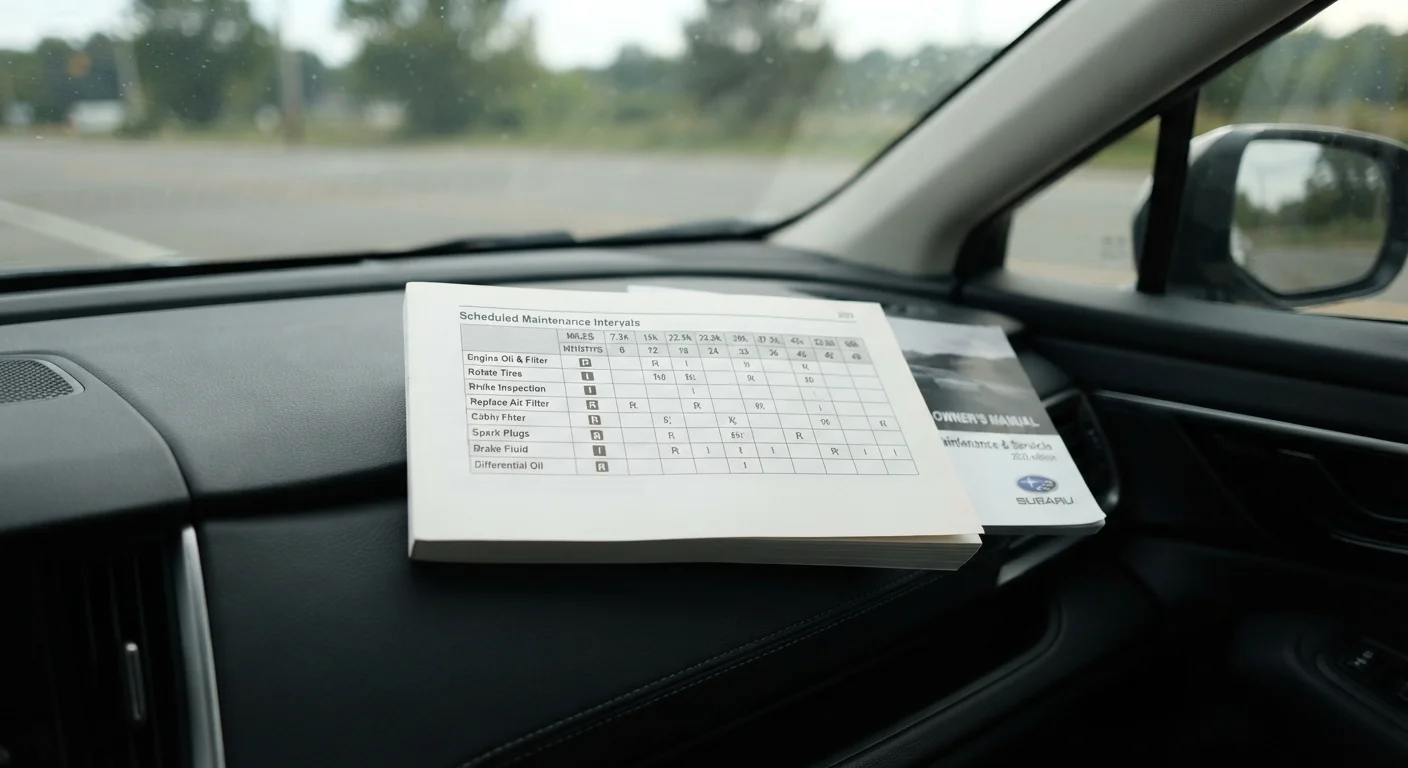
The maintenance schedule covers every system that requires routine attention: engine oil and filter, tire rotation, brake inspection, coolant, transmission fluid, air filters, spark plugs, belts, and more. Not all of these come due at the same time, which is exactly why the schedule exists - it spaces out services across mileage milestones so nothing gets overlooked.
Normal vs. Severe: Know Which Applies to You
Many drivers assume they fall under the "normal" driving schedule, but the severe category applies more broadly than most expect. Short trips under five miles, frequent stop-and-go traffic, extreme heat or cold, dusty environments, and towing or hauling heavy loads all qualify as severe conditions. If your daily commute fits any of those descriptions, follow the more frequent severe schedule to avoid premature wear.
Once you've identified your correct schedule type, use the steps below to read your manual's intervals accurately and set up a tracking system that actually works. For services that involve hands-on work, knowing which tasks are safe to do yourself versus which require a qualified mechanic can help you plan appropriately.
What you will need
Owner's Manual
The primary source for your vehicle's manufacturer-specified maintenance intervals and service requirements.
Current Odometer Reading
Required to determine where you are in the maintenance schedule relative to mileage-based service intervals.
Notebook or Maintenance Log App
Used to record completed services, dates, and mileage so you always know what's been done and what's coming due.
Locate the Maintenance Schedule Section
Owner's manuals are organized into chapters. Look for a section labeled "Maintenance," "Scheduled Maintenance," or "Maintenance Schedule" - it's usually in the second half of the manual. Some vehicles also include a separate, shorter maintenance booklet in the glove box alongside the full manual. Either source works; just make sure it matches your specific model and engine type if multiple configurations exist.
Identify Whether You Drive Under Normal or Severe Conditions
Before reading the schedule itself, find the section that defines normal versus severe driving. This distinction changes how frequently many services are required. Severe conditions are not just for off-road use - frequent short trips, heavy traffic, dusty roads, and towing all count. Choosing the correct category from the start means the intervals you track will actually match how your car is being used.
Read the Interval Columns Correctly
Maintenance schedules are laid out as a grid. Rows list services - oil change, tire rotation, air filter, transmission fluid, spark plugs, and so on. Columns show intervals, typically in miles (e.g., every 5,000, 15,000, or 30,000 miles) and often in months as a parallel measure. A service due at "every 15,000 miles or 12 months" should be performed at whichever threshold you reach first - not whichever is more convenient.
Note Your Current Mileage and Calculate What's Due
Check your odometer and write down the number. Then work through the schedule to identify which services you're currently approaching or have already passed. If you're not sure what's been done on a used vehicle, a qualified mechanic can inspect key components to help establish a starting baseline. Going forward from a known point is far better than guessing.
Start a Simple Service Log
Each time a service is completed, write down the date, the mileage at the time, and what was done. A small notebook kept in the glove box works fine, as does a notes app on your phone. This log gives you an instant reference for what's current and what's coming up, helps you communicate clearly with mechanics, and serves as documentation that maintenance was performed - which matters both for warranty purposes and when selling the vehicle.
Set Reminders for Upcoming Services
Once you know what's due and when, set calendar reminders for upcoming intervals. A reminder at 1,000 miles or one month before a service is due gives you enough lead time to schedule an appointment without scrambling. Some vehicles with newer infotainment systems can display service reminders on the dashboard - check your manual to see if yours has this feature and how to enable it.
Don't Rely on Memory or Stickers Alone
Oil-change stickers placed on your windshield by service shops are set to that shop's standard interval - not necessarily the one specified for your car. They can be a useful reminder, but they shouldn't override what your manual actually says. Always cross-reference any service recommendation with your own manual.
Some maintenance items - like wheel alignment - don't always appear on a fixed mileage schedule but still require periodic attention. Understanding why wheel alignment matters can help you know when to ask about it. For a broader seasonal perspective that complements your manual's schedule, a season-by-season check-up routine can fill in the gaps.