What Alignment Actually Controls
Your car's wheels aren't bolted on in a perfectly vertical, perfectly parallel position by accident. Engineers specify precise angles for each wheel to balance straight-line stability, cornering grip, and tire longevity. When those angles are correct, the tire tread contacts the road evenly across its full width - that even contact is what makes tires last and handling feel solid.
The three angles technicians measure are camber (how much the tire tilts in or out when viewed from the front), toe (whether the fronts of the tires point slightly inward or outward like pigeon-toed feet), and caster (the angle of the steering axis that influences stability at speed). Toe is usually the biggest culprit in rapid tire wear - even a small toe error makes the tire scrub sideways against the pavement with every rotation.
Front-Wheel vs. Four-Wheel Alignment
Some vehicles only allow adjustment at the front axle due to their rear suspension design, while others support four-wheel alignment where all four corners are measured and adjusted. A technician can tell you which applies to your vehicle. Four-wheel alignment provides a more complete picture of how the axles relate to each other and is generally recommended when the design allows it.
What Throws Alignment Off
Alignment doesn't just drift randomly - something physical moves or wears to shift those angles out of spec. The most common causes include:
- Potholes and rough roads: A hard impact can jar suspension components out of position in a single hit.
- Curb strikes: Parking nudges and accidental curb contact are a frequent, underestimated source of misalignment.
- Worn suspension parts: Ball joints, tie rod ends, and control arm bushings develop play as they age. When those parts shift under load, the wheel angles shift too.
- Minor collisions: Even a low-speed fender bender can bend steering or suspension geometry.
This is part of why small maintenance habits compound over time - ignoring a worn suspension component doesn't just affect ride comfort, it can accelerate alignment drift and tire wear simultaneously.
The Real Cost of Ignoring It
~$100-$175
Typical cost of a four-wheel alignment
Industry service pricing data suggests a standard four-wheel alignment commonly falls in this range at independent shops, far less than a new set of tires.
25%+
Potential tire life reduction from misalignment
Automotive maintenance sources note that sustained misalignment can reduce usable tire life by a quarter or more, depending on how far out of spec the angles are.
Tires are among the most expensive consumables on a vehicle. Misalignment doesn't just shorten their lifespan - it shortens it unevenly, often making one edge of a tire wear through while the rest still has tread left. That means you're replacing tires earlier and getting less value from each set.
Beyond tires, sustained misalignment forces suspension and steering components to work at unintended angles under load, accelerating wear on parts like tie rod ends and ball joints. A wheel alignment service is relatively inexpensive; the parts it protects are not. For context, skipping routine maintenance of any kind tends to move costs from small and scheduled to large and unexpected.
Check Alignment After New Tires or Suspension Work
Any time suspension components are replaced - or whenever you put on a new set of tires - it's worth confirming alignment is within spec. New tires on a misaligned car will wear unevenly from day one, shortening a tire life you've just paid for. Many shops include an alignment check as part of tire installation.
Signs to Watch For and What Getting It Fixed Involves
The clearest warning signs of misalignment are a car that pulls to one side on a flat, straight road; a steering wheel that doesn't sit centered when driving straight; and tires showing uneven tread wear across their width. Vibration can also be a symptom, though it more commonly points to tire balancing issues rather than alignment alone.
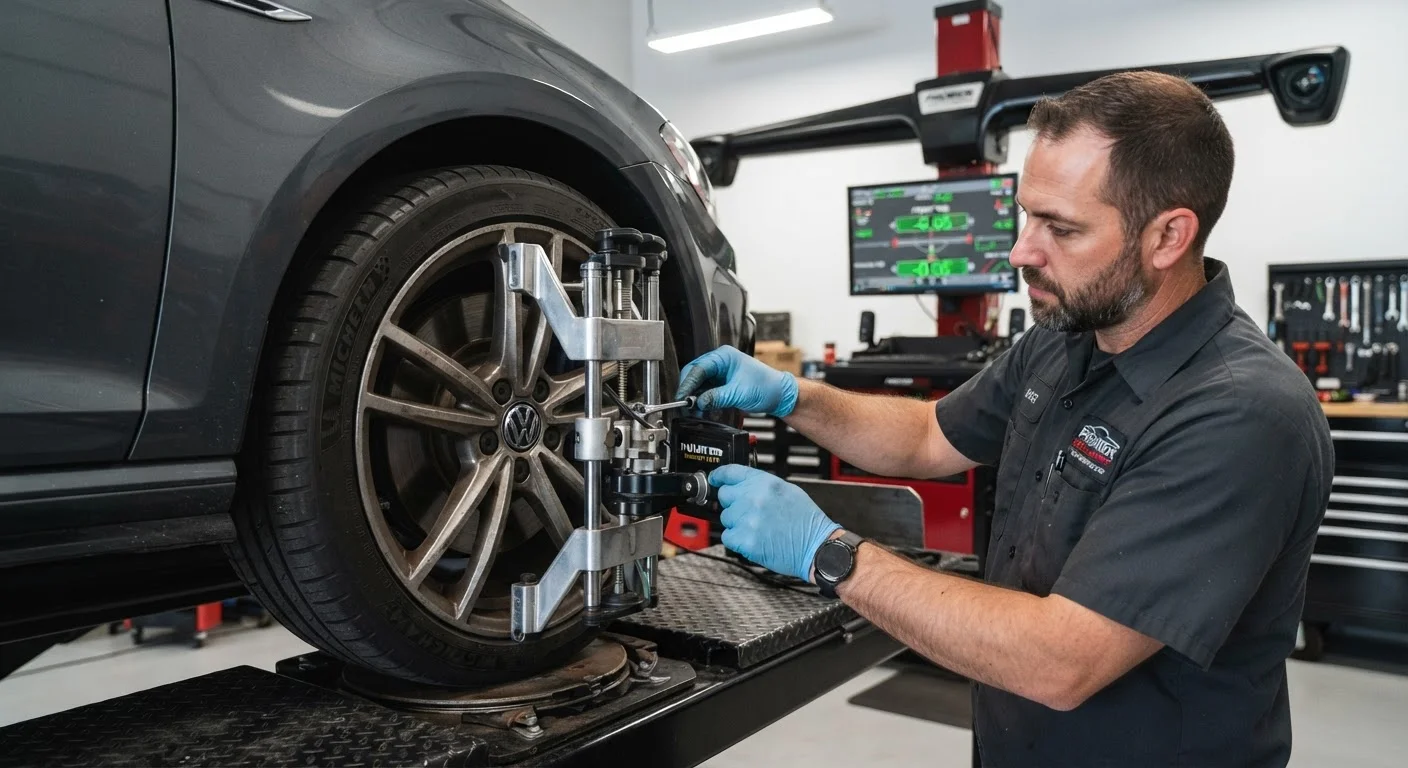
An alignment service involves placing sensors on each wheel and using a computerized alignment rack to measure the actual angles. A technician then adjusts adjustable suspension components - typically tie rods for toe and, where the design allows, control arm bolts for camber - until each angle falls within the manufacturer's specification. The process usually takes under an hour for a standard passenger vehicle.
It's worth pairing an alignment check with tire rotations and keeping tires at the correct pressure, since all three factors work together to determine how evenly and how long your tires wear. Your owner's manual maintenance schedule may specify an alignment interval; if not, once a year or after any notable road impact is a reasonable general guideline.