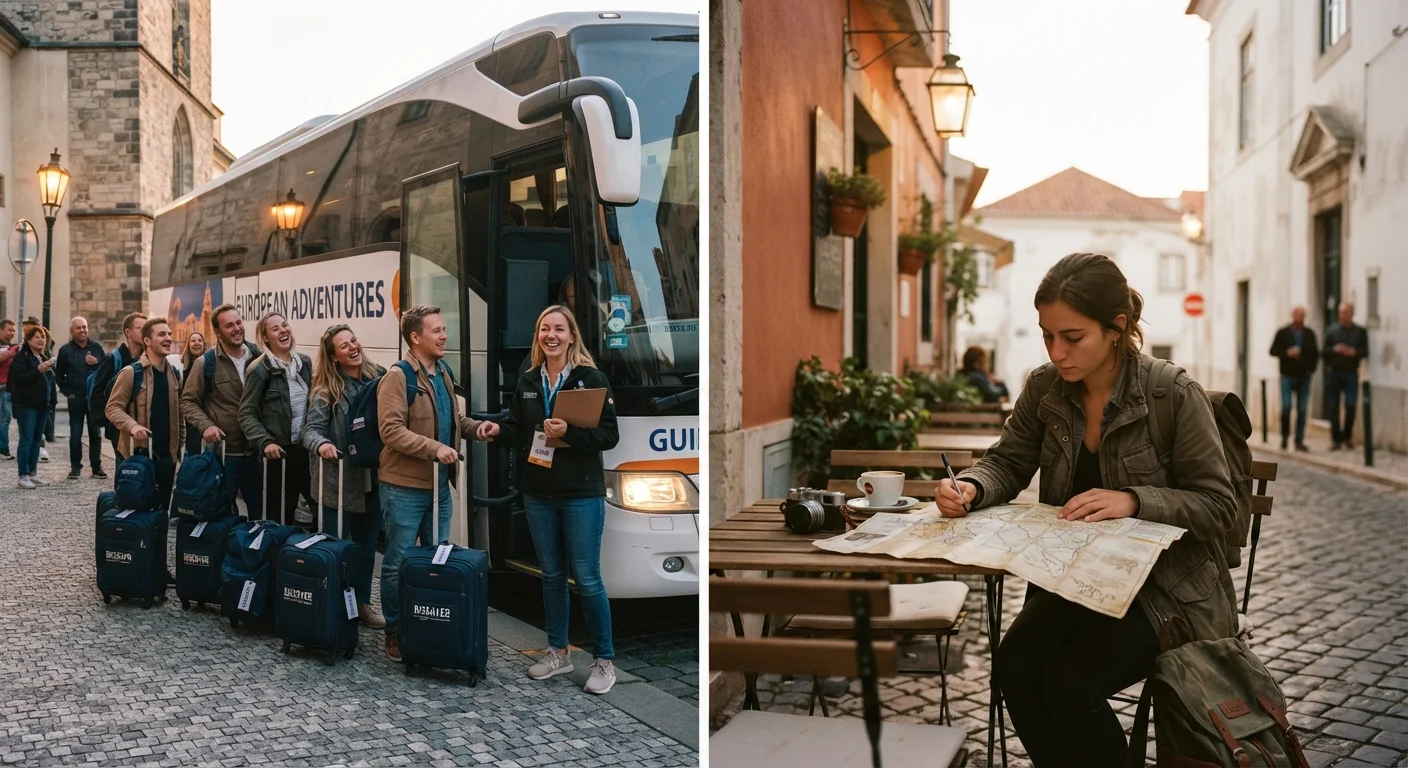

The Two-Week, Seven-Country Dream
It starts with a map and a highlighter. Paris, Amsterdam, Prague, Vienna, Budapest, Rome, Barcelona - seven cities, two weeks, one trip. It feels thrilling on paper, and the logic seems sound: flights are expensive, time off is limited, Europe is right there. Why not see as much as possible?
The problem is that this math almost never survives contact with reality. What looks like an efficient itinerary on a screen routinely becomes an exhausting blur of train stations, half-eaten meals, and landmarks glimpsed from a taxi window. The trip you described to friends afterward - "we did all of Western Europe" - rarely matches the trip you actually experienced.
Understanding why this happens is the first step toward planning something better. These are the most common mistakes that turn a European adventure into a footrace.
Treating transit time as zero cost on the itinerary.
Why it happens: Digital maps show city-to-city distances as manageable, but travelers forget to account for getting to and from stations, delays, check-in windows, and the mental fatigue of repeated travel days.
Scheduling arrival and departure cities that require backtracking.
Why it happens: Travelers often book the cheapest flights independently without plotting a logical geographic arc, resulting in itineraries that zigzag across the continent.
Underestimating jet lag's effect on the first two days.
Why it happens: Most travelers from the US arrive in Europe having lost a night of sleep, but immediately launch into sightseeing to "make the most" of their first day.
Over-programming every hour with ticketed attractions.
Why it happens: Fear of long queues and limited availability pushes travelers to pre-book back-to-back museum slots, tours, and experiences, leaving no room for flexibility or rest.
Choosing accommodation based on price without considering location.
Why it happens: Peripheral neighborhoods often offer cheaper rates, but the additional commute time into city centers quietly adds hours of transit to each day.
The Hidden Cost of Moving Every Day
Every time you change cities, you lose somewhere between three and six hours to logistics: packing, checking out, reaching the station or airport, waiting, traveling, arriving, navigating to accommodation, and settling in. On a ten-day trip with eight destinations, that overhead can consume two full days of your journey - days that never appear on the itinerary but quietly drain your energy.
3-6 hrs
Typical time lost per city change
Travel researchers and itinerary planners consistently note that logistics - packing, transit, check-in - consume several hours each time travelers move between destinations.
2 nights
Minimum stay for meaningful experience
Experienced travel writers broadly recommend at least two nights in any destination to have a single full day free from arrival and departure logistics.
Experienced travelers often describe a simple rule: if you're staying somewhere fewer than two nights, you're probably not actually visiting - you're just passing through. Two nights gives you one full day, which is rarely enough to understand a city beyond its most photographed corner. Three nights begins to feel like a stay. Consider habits seasoned travelers rely on, including deliberately building buffer days that absorb delays and leave room for genuine discovery.
The antidote isn't booking less - it's choosing fewer places and staying longer. A week split between two regions of Italy will almost certainly feel richer than the same week divided across four countries. You'll eat better, sleep more, and leave with stories rather than just photos.
Spontaneous Changes Cost More in Europe
Changing trains, booking last-minute accommodation, or rerouting mid-trip in Europe can be significantly more expensive than pre-planned arrangements - especially during peak summer months. Build flexibility into your itinerary by choosing fewer destinations, not by assuming you can freely pivot once you're there.
Before locking in any itinerary, it's worth researching each destination thoroughly - including realistic transit times, seasonal crowds, and local rhythms that shape how a place actually feels to visit. And if you're traveling with others, the trade-offs between group and independent travel become even more pronounced when the itinerary is already packed.
Planning for the Trip You'll Actually Take
The most rewarding European trips tend to share a quality that rushed itineraries never achieve: they make room for things that weren't planned. The afternoon a storefront bakery pulls you in, the conversation with a local that redirects your afternoon, the square you stumble onto at golden hour - these are the moments travelers recall years later. They require slack in the schedule.
That means resisting the pull of completionism. Many destinations carry assumptions that don't hold up once you arrive - popular travel destinations are frequently misunderstood in ways that affect how you should plan around them. A city famous for one thing may reward you most for something else entirely, but only if you have time to wander beyond the guidebook.
Overpacking your schedule shares the same psychology as overpacking your luggage: both stem from a fear of missing out, and both make the trip harder. The fix in each case is the same - trust that less, chosen well, delivers more. Europe will still be there. The version of the trip worth remembering is the one where you had time to actually be somewhere.
This article provides general travel planning information. Visa requirements, transportation schedules, and entry conditions vary by nationality and destination - always verify current details with official government and carrier sources before traveling.